
The problem most creative teams face in 2026 is not a shortage of data. It is a shortage of structure. There are more sources of fashion intelligence available now than at any point in the industry's history — free tools, AI platforms, runway archives, consumer signal dashboards — and most creative teams are using one or two of them, inconsistently, without a clear understanding of what each one is designed to answer. The result is not better decisions. It is louder noise.
The Stack Problem — One Tool Cannot Answer All the Questions
A direction decision is not a single question. It is a series of questions, asked in sequence, each requiring a different type of intelligence to answer with precision.
What emotional state is my consumer currently seeking? What colours are carrying that emotional register on the runway right now, and where are they in their adoption trajectory? Is my creative brief emotionally coherent — does each design decision serve the same named emotional intention? And when a specific design, colour, or silhouette choice is made, does it hold up against the live signal data before the sampling cost is committed?
These are four different questions. They require four different types of intelligence. No single tool — no matter how sophisticated — answers all of them equally well. The Creative Directors who make the most consistent direction decisions are not the ones with access to the most data. They are the ones who have built a layered intelligence stack where each tool has a specific job, and every decision is informed by the right type of intelligence at the right stage of the process.
The question is not which single tool gives you the best intelligence. The question is which combination of tools gives you the right intelligence at each stage of the creative process — and whether you know which one you are consulting, and why, at every moment.
This article maps the Creative Director's intelligence stack for 2026 — four tiers, from free cultural signal tools through to AI-powered design validation. It covers what each tier is genuinely good for, where it falls short, and how the tiers work together as a system. F-Trend is one part of this stack — an important one, but one part. The full picture is more useful than any product recommendation.
The Four-Tier Intelligence Stack
The stack is organised around the sequence of questions a Creative Director needs to answer in the direction development process — from the broadest cultural reading to the most specific design decision. Each tier answers a different question and draws on different data. The tiers are not interchangeable, and they are not redundant. Each one adds a layer that the others cannot provide.
The first tier reads the broad cultural landscape — what consumers are searching for, engaging with, and gravitating toward across platforms and contexts. This is the earliest signal in the intelligence chain. It precedes trend adoption — it is the emotional and cultural appetite that trends eventually respond to. A Creative Director who reads this tier well does not follow trends. They understand the conditions that produce them.
Tracks search volume over time for any keyword or topic, with geographic breakdown and related query data. For a Creative Director, the most useful application is not searching for colour or trend terms — it is tracking the emotional and lifestyle language that surrounds a trend. Searching "dark romance fashion" alongside "cottagecore" alongside "quiet luxury" gives a reading of which emotional registers are building consumer appetite and which are saturating.
It shows what people are searching, not why. And search behaviour lags cultural emergence by weeks or months — the signal is real but not early.
Pinterest's user base is actively aspirational — they are saving images of things they want to acquire or become. This makes Pinterest Trends one of the most reliable early-signal tools for fashion and lifestyle aesthetic direction. A mood or visual language that is building saves on Pinterest in January often surfaces in consumer fashion behaviour by summer. The Predicts feature publishes annual forecasts of what the platform expects to trend based on save velocity.
It skews toward a specific demographic (predominantly female, 25–45, aspirational lifestyle) and reflects aesthetic preference rather than emotional architecture. Useful for identifying visual direction; insufficient on its own for emotional specification.
Published quarterly, the Lyst Index tracks consumer search and purchase intent across 200+ luxury and contemporary brands. It is one of the few publicly available sources of actual consumer demand signal — not editorial opinion, not runway observation, but what people are actively searching for and buying. For a Creative Director at a contemporary brand, the Lyst data reveals which design directions at luxury level are translating into real consumer demand — the leading indicator for contemporary adoption.
Only covers the premium-to-luxury segment. No mass-market or fast fashion signal. Published quarterly — not live.
Platform-native analytics give a reading of which aesthetics, garments, and styling references are generating engagement — and crucially, the demographic profile of who is engaging. For a Creative Director, the most useful signal is not what is going viral but what is being saved, shared in close-friend circles, and referenced in comment sections as aspirational. These are the emotional signals that precede trend adoption.
Highly noisy. Requires significant curatorial discipline to distinguish genuine early-signal from algorithm-amplified noise. The platform optimises for engagement, not cultural significance — the two are frequently different things.
The runway is still the primary origin point for fashion colour and silhouette signals in Western markets. It is where new aesthetic directions first appear in a context that carries creative credibility — and where the adoption trajectory begins. Runway intelligence tracks what is appearing, at what frequency, from which designers, in which markets, and how that presence is evolving season over season. This is the tier that moves from cultural intuition to creative evidence.
The most comprehensive publicly available archive of runway imagery from Paris, Milan, New York, and London fashion weeks, spanning multiple decades. For research and reference — understanding how a silhouette or colour direction has evolved over seasons, identifying which designers have been consistent carriers of a particular aesthetic — the Vogue Runway archive is unmatched. The search and filter functionality allows drilling down by designer, season, and look.
Editorial and archival — not analytical. Tells you what is there; does not tell you frequency, trajectory, or adoption velocity. Manual and time-intensive for any quantitative analysis.
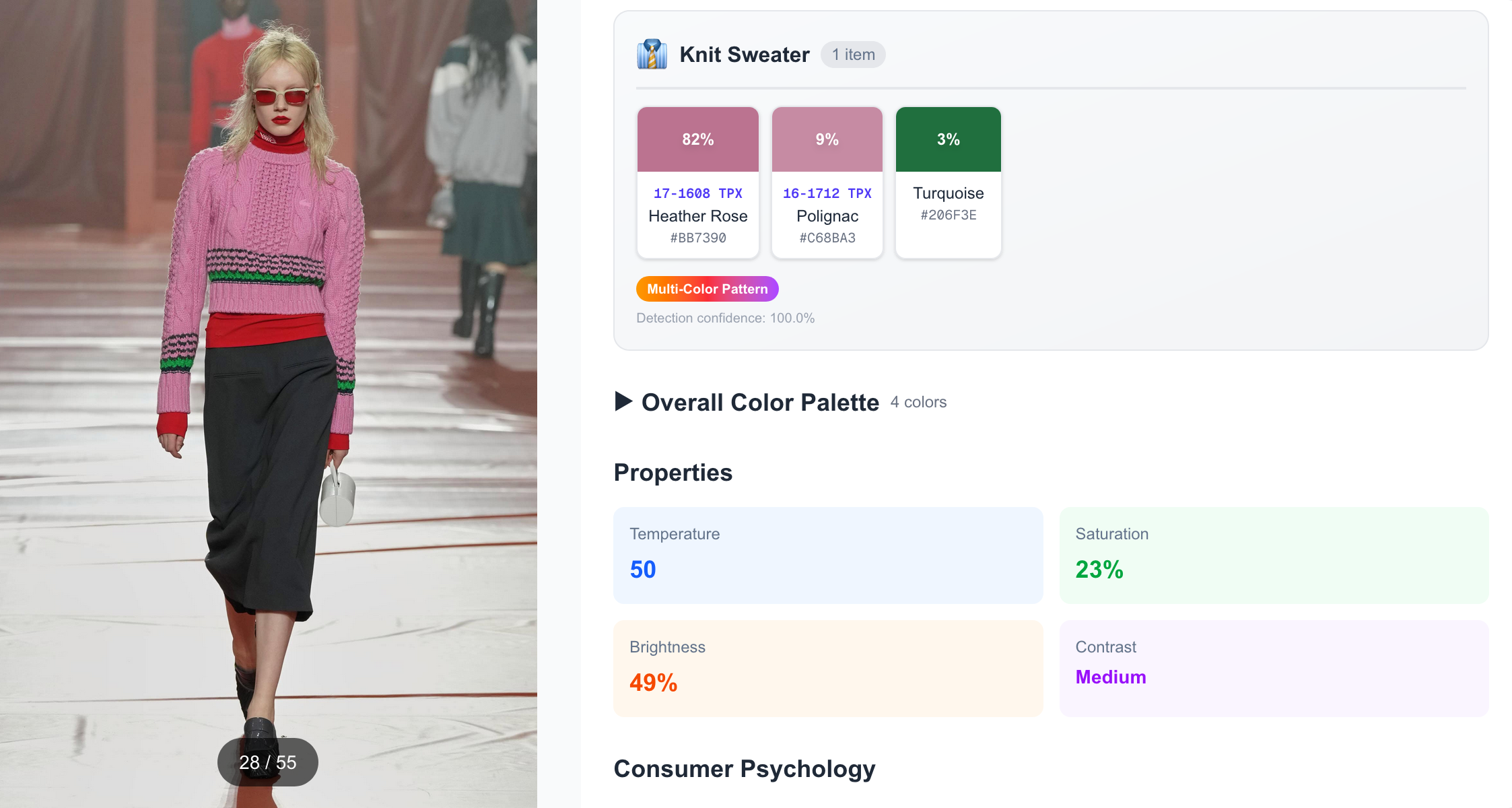
AI-powered analysis of 16,000+ runway designs across 50+ global fashion weeks, spanning eight seasons. The ColorAnalyzer extracts precise colour palettes with Pantone TPX matching, tracking each colour's runway occurrence frequency across seasons — giving the trajectory arc from first appearance to projected decline. The SilhouetteAnalyzer identifies garment types, fit profiles, and silhouette evolution. The PatternAnalyzer tracks print and texture adoption rates. Filters by region, season, designer, and gender allow hyper-specific analysis — for example: oversized silhouettes in earth tones from Paris Fashion Week SS25 womenswear.
The trajectory data is the most commercially significant output. A colour appearing at 9 occurrences in SS24 and 122 occurrences in SS26 tells a precise story about adoption velocity — and projects where that trajectory goes next. This is the leading indicator for consumer adoption that the manual archive cannot provide.
Runway data tracks the industry's creative output, not yet consumer behaviour directly. The runway signal is a leading indicator — it requires cross-referencing with consumer signal data (Tier 1 and Tier 4) to confirm that the runway trajectory is translating into consumer appetite.
This is the tier that most Creative Directors are missing — and it is the one that determines whether a collection is technically correct or genuinely powerful. Tiers 1 and 2 tell you what is happening in the cultural and creative landscape. Tier 3 tells you why it is happening, at the level of human emotional need — and how to specify design decisions that deliver precisely the right emotional experience to the right consumer persona.
The methodological frameworks in this tier are not software tools. They are analytical instruments — ways of processing intelligence from the other tiers into emotionally precise design decisions.
The EI Circumplex positions every colour, fabric, and silhouette decision at its precise Arousal × Pleasure coordinate — the intersection of energy level and emotional valence that determines what emotional state a design element triggers in the consumer at first contact. High Arousal + Mid Pleasure is the Passion register: deep reds, velvet weight, dramatic silhouette. Low Arousal + High Pleasure is Serenity: sage, dusty blue, fluid drape. The Circumplex gives the Creative Director a coordinate system for every design decision — replacing vague aesthetic language with named emotional positions that can be evaluated objectively.
Requires trained application — it is a methodology, not a dashboard. The value compounds with practice; the first time a team uses the Circumplex in a palette review, it adds time. By the third season, it eliminates ambiguity.
Personality × Purpose = Value × Product. The P²VP framework structures the consumer persona definition that precedes every colour and design decision. The same colour triggers entirely different emotions depending on the personality and purpose of the receiver — Burgundy signals Passion to the Romantic Dominant persona and unease to the Security-first persona. Colour is identical; emotional response is not. P²VP ensures that persona identification precedes every colour decision, so the design team is always specifying colours for a named person with a named emotional need, not for an abstract consumer.
Requires investment in persona development — the framework is only as good as the precision of the persona definition it is applied to. Shallow persona work produces shallow direction specification.
The Positive Emotion Granularity Filter converts vague creative language into named emotional states — and named emotional states into specific, measurable design decisions. "Make it romantic" → Passion → Deep red, Burgundy, Saturation 62%. "Make it mysterious" → Mystery → Midnight, Deep Plum, Brightness 18%. "Make it luxurious" → Serenity → Dusty Rose, Brightness 70%, Saturation 25%. Every design review conversation becomes precise. Disagreements become evaluable against a named criterion. The brief closes.
Requires team adoption — a PEG Filter is only useful if everyone in the room is using the same emotional vocabulary. It is a shared language tool as much as an analytical one.
The structured practitioner course that teaches the HPEI framework, EI Circumplex, P²VP, and PEG Filter as an integrated methodology. The course takes a Creative Director or Colour Specialist from macro trend signal through consumer persona architecture through palette specification through seasonal arc planning — producing a Final HPEI Design Brief as the deliverable. For teams that want to build the Tier 3 methodology as a permanent part of their creative process rather than applying it ad hoc, TrendClass is the systematic route.
Investment of time: 3 hours plus applied exercises per module. This is a practitioner course, not a reference tool — the value is in the methodology becoming fluent, not in being consulted occasionally.
The fourth tier applies intelligence at the most granular level of the creative process — the individual design decision. It is where the emotional architecture of Tier 3 and the runway trajectory data of Tier 2 are applied to a specific garment, a specific colour choice, a specific silhouette decision, and validated against live consumer signal data before any production cost is committed. This is the tier where the intelligence investment pays its most direct return.
Live trajectory tracking for 1,200+ colour trends with Pantone TPX matching across 2.5 million data points. For each colour, the platform surfaces the runway occurrence trajectory across seasons (the adoption arc from first signal to projected decline), the consumer signal strength by market and demographic, the EI position and psychological profile, the consumer archetype currently embodying the colour, and the cross-industry emotional vectors — what adjacent categories (beauty, activewear, interiors) are doing with the same emotional register. 6 to 12 month colour forecasts with seasonal evolution tracking give the forward view alongside the present-tense reading.
The practical application: at palette finalisation, every candidate colour is checked against the live trajectory signal. Is it in the growth phase, at peak, or post-peak for the target consumer and market? Is its EI position aligned with the planned emotional architecture from Tier 3? Are there any colours in the palette that are emotionally misaligned — present because they are trending but positioned in the wrong emotional register for the brief?
Most powerful when used alongside the Tier 3 emotional architecture work. Color Intelligence data is the validation layer — it confirms or challenges the emotional decisions made in the palette development process. Used without the emotional framework, it produces trajectory data without the interpretive context to act on it precisely.
Upload a sketch, tech pack, or product image and the platform analyses the design across four dimensions simultaneously: colour (Pantone TPX extracted, trajectory checked, EI position evaluated), silhouette (shape and fit classified, compared against 8 seasons of runway data), pattern or print (adoption rate assessed, commercial viability scored), and fabric (material composition identified, trend alignment evaluated). The output is a Go/No-Go confidence score with dimension-specific feedback — in under 60 seconds, before any sampling cost is committed.
The colour layer specifically checks each colour in the design against its current trajectory and its EI position relative to the season and target persona. A design that is emotionally coherent but timing-misaligned on colour is flagged. A design with a hero colour in post-peak decline is flagged. The creative team retains full discretion over the decision — the intelligence surfaces the information, it does not override the judgement.
The Go/No-Go score is a confidence measure, not a verdict. A low score on a specific dimension is a prompt to interrogate the decision more carefully — not an automatic rejection. The most effective use combines the platform's output with the creative team's informed judgement.
The free entry point into the F-Trend platform — a moodboard creation tool built from live trend and signal data rather than static image libraries. For Creative Directors beginning to build a direction, the Moodboard Studio allows the initial creative reference to be assembled from intelligence-informed sources — colours, silhouettes, and references that are tagged with their live trajectory and signal data. The moodboard becomes a working document rather than a static aesthetic reference.
A starting point, not a complete intelligence tool. The depth of trajectory and emotional analysis available in Color Intelligence and Design Viability Check is not replicated in the free tier.
How the Stack Works — The Sequence That Matters
The four tiers are not used simultaneously. They are used in sequence — each tier informing the next, each question answered before the next one is asked. The sequence is the intelligence practice. Using all four tiers out of sequence, or pulling from multiple tiers simultaneously without a clear decision framework, produces the same confusion as using one tool for everything.
Stage 1 — Read the Cultural Climate (Tier 1)
Google Trends, Pinterest Trends, social listening. Question: what emotional appetite is the consumer developing? What cultural conditions are producing demand for which emotional experiences? Output: an emotional brief — not a colour direction, an emotional direction.
Stage 2 — Identify the Emotional Architecture (Tier 3)
EI Circumplex, P²VP Framework, PEG Filter. Question: which emotional states map to which EI Circumplex positions for our defined consumer persona? What named emotions must this collection deliver? Output: the emotional specification — target EI positions, named emotions, consumer persona, wearing verdict.
Stage 3 — Read the Runway Signal (Tier 2)
F-Trend AI Catwalk Analytics. Question: which colours, silhouettes, and patterns are currently carrying the emotional registers we have specified — and where are they in their adoption trajectory? Output: the creative evidence base — runway-validated direction with trajectory data.
Stage 4 — Validate Individual Decisions (Tier 4)
F-Trend Color Intelligence, Design Viability Check. Question: does this specific palette, colour, and design decision hold up against live consumer signal data and the EI brief? Output: Go/No-Go confidence scores by dimension, with trajectory and emotional alignment flags.
The output of each stage is the input to the next. Skip a stage and the subsequent stage is answering a different question than the one the brief requires.
The Right Stack for Your Team — Three Configurations
The full four-tier stack is the complete intelligence practice. But not every team starts there, and not every team needs every tool from day one. The right configuration depends on team size, creative maturity, and where the most significant intelligence gaps currently sit.
- Google Trends (free)
- Pinterest Trends (free)
- F-Trend Moodboard Studio (free)
- F-Trend Design Viability Check (paid)
- PEG Filter (methodology — self-taught)
- Google Trends + Lyst Index (free)
- F-Trend AI Catwalk Analytics (paid)
- F-Trend Color Intelligence (paid)
- F-Trend Design Viability Check (paid)
- EI Circumplex + P²VP (methodology)
- TrendClass Module 06 (paid course)
- Full Tier 1 stack + social listening tools
- Vogue Runway Archive (reference)
- F-Trend AI Catwalk Analytics (paid)
- F-Trend Color Intelligence (paid)
- F-Trend Design Viability Check (paid)
- Full HPEI methodology (TrendClass)
- F-Trend IaaS consultancy (seasonal)
The most common intelligence gap across all three team sizes is Tier 3 — the emotional architecture methodology. Most teams have some version of Tier 1 (cultural observation) and some version of Tier 2 (runway reference). Very few have a structured methodology for translating those observations into emotionally precise design decisions with named criteria for evaluation. This is where the most significant precision gains are available, and it is the tier that requires the least financial investment relative to the improvement it delivers.
What the Intelligence Stack Does Not Do
A stack of tools, however well chosen and sequenced, does not replace creative judgement. It is important to be precise about this — because the risk of misunderstanding the role of intelligence in the creative process runs in both directions.
The Creative Director who dismisses intelligence tools entirely — "I trust my instinct, data kills creativity" — is operating with incomplete information and calling the incompleteness a virtue. Their direction decisions carry unnecessary uncertainty, and when they go wrong, the failure is invisible in the process because the process contained no checkpoints.
But the Creative Director who over-delegates to the intelligence stack — who waits for a Go/No-Go score before making any creative commitment, who will not place a colour in a palette unless the trajectory data confirms it — has outsourced their creative authority to a system that was not designed to hold it. The intelligence surfaces information. The creative judgement decides what to do with it.
The intelligence stack is not a decision-making system. It is a decision-informing system. The decision belongs to the Creative Director. The stack's job is to make sure that decision is made with the best available information — not to make it.
The most productive relationship between creative intelligence and creative judgement is one in which the intelligence is consulted in a structured sequence, its output is understood precisely for what it is and is not, and the creative team retains full authority over the direction while being genuinely informed by the data. The stack serves the creative vision. Not the other way around.
Building the Stack — A Starting Point
The Creative Director who reads this article and attempts to implement all four tiers simultaneously will be overwhelmed. The right approach is to identify the single biggest intelligence gap in the current creative process and add one tool or methodology to address it.
For most creative teams in 2026, that gap is in Tier 3. Not the absence of runway data — most teams have access to runway references. Not the absence of cultural signal tools — most teams are reading social media and trend reports. The gap is in the methodology that translates those signals into emotionally precise design decisions. The PEG Filter. The EI Circumplex. The discipline of naming the emotion before choosing the colour.
Start there. Add the EI Circumplex to the next palette review. Run the next brief through the PEG Filter. See what changes in the quality of the conversation — what becomes precise that was previously vague, what becomes evaluable that was previously a matter of opinion. Then build outward from that foundation, adding the intelligence tools that validate and extend the methodology.
The stack is a practice, not a purchase. The tools are only as good as the sequence in which they are used and the questions they are asked to answer. Get the sequence right, and the intelligence compounds. Get the questions right, and the tools become instruments rather than data sources.
F-Trend Tools Referenced in This Article
- AI Catwalk Analytics — ColorAnalyzer · SilhouetteAnalyzer · PatternAnalyzer · 16,000+ designs · 8 seasons · $99 30-day trial
- Color Intelligence — 1,200+ colours · Pantone TPX · EI position mapping · trajectory tracking · 2.5M+ data points
- Design Viability Check — Go/No-Go scoring for colour, silhouette, pattern, fabric · under 60 seconds
- Moodboard Studio — free · intelligence-informed moodboard creation from live trend data
- Trend Acdemy — HPEI · EI Circumplex · P²VP · PEG Filter · full practitioner methodology