
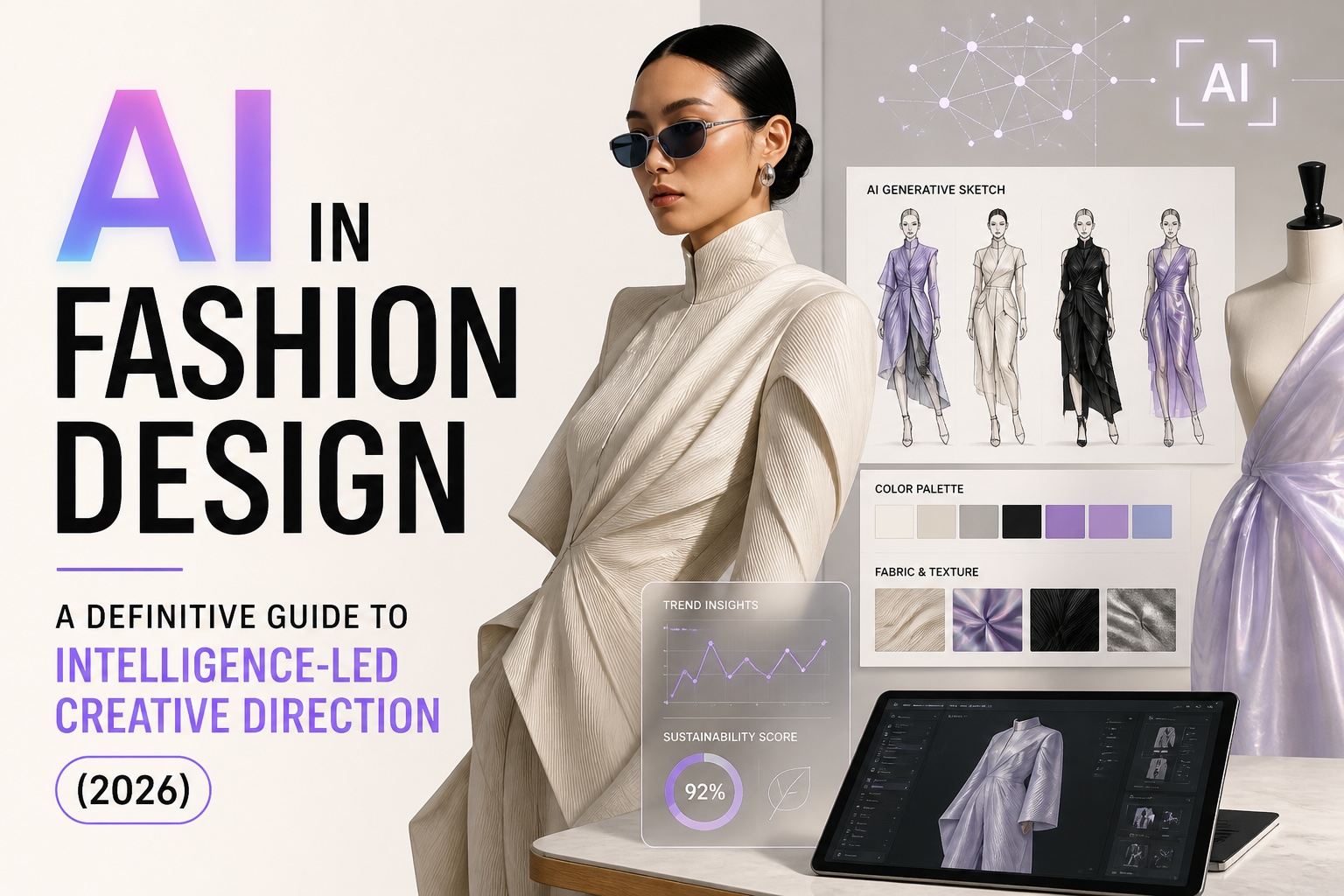
AI is already in your creative process — whether you have chosen it or not. The question is no longer whether artificial intelligence belongs in fashion design. It is whether you understand what it is actually doing, which categories of AI serve which creative decisions, and how to use it with enough precision to make your direction more confident rather than more confused. This is that guide.
Why Most Writing About AI in Fashion Gets It Wrong
The conversation about AI in fashion has a structural problem. It conflates three entirely different categories of technology under a single term — and then generates either utopian enthusiasm or defensive anxiety about all three simultaneously, without ever being precise about which one is actually under discussion.
A Creative Director reading about "AI in fashion" might encounter an article about generative image tools in the same paragraph as a discussion of demand forecasting algorithms, followed immediately by a reference to consumer signal analysis platforms. These are not the same technology. They do not do the same thing. They do not serve the same decisions. And understanding the difference between them is the first and most important step in using any of them effectively.
The most useful thing a Creative Director can do with AI in 2026 is not adopt it. It is understand precisely what it is, what it is designed to do, and where in the creative process it earns its place.
This guide makes that distinction clearly. It defines the three categories of AI in fashion, explains what each one is genuinely good for, addresses their real limitations honestly, and maps where intelligence AI — the category most directly relevant to creative direction decisions — fits into the design process alongside human creative judgement.
The Three Categories of AI in Fashion Design
There are three distinct categories of AI application in fashion design. They are not interchangeable. Each answers a different question, draws on different data, and serves a different stage of the creative and commercial process.
Creates visual outputs from text prompts or reference images. Used for concept exploration, moodboard generation, rapid iteration of silhouettes, colour combinations, and print directions. Tools: Midjourney, Adobe Firefly, DALL-E, Stable Diffusion. Answers aesthetic and visual questions at the ideation stage.
Statistical models applied to historical sales, inventory, and consumer behaviour data to forecast future commercial outcomes. Used internally by large retailers for demand planning, markdown optimisation, and assortment decisions. Answers commercial and operational questions at the buying stage.
Consumer signal analysis, trajectory tracking, emotional architecture mapping, design validation. Answers creative and directional questions at the design and palette development stage. F-Trend's domain. This is the category most relevant to Creative Directors and Colour Designers.
Most of the anxiety about AI in fashion — the fear that it will homogenise creative output, replace creative judgement, or reduce fashion to an algorithm — is directed at Generative AI. Some of it is directed at Predictive AI in its bluntest commercial form. Very little of it is relevant to Intelligence AI used correctly — because Intelligence AI does not generate anything and does not replace creative decisions. It informs them with data that would otherwise be unavailable or too slow to process manually.
This guide focuses primarily on Intelligence AI — the category most underused, most misunderstood, and most directly relevant to the quality of creative direction decisions. But it covers all three fairly, because a Creative Director who understands the full landscape is better positioned to use any part of it well.
Category OneGenerative AI — The Ideation Accelerator
Generative AI tools — Midjourney, Adobe Firefly, DALL-E, and their successors — can produce fashion imagery, silhouette concepts, colour combinations, print directions, and moodboard references at a speed and volume that no human team can match. For the ideation and concept exploration phase of design, this is a genuine capability expansion. A Creative Director can test twenty silhouette directions in the time it previously took to produce two, iterate rapidly on colour combinations without committing to sampling, and explore cultural and aesthetic references across a breadth that a team without AI assistance cannot access.
This is real value. The creative practitioner who dismisses generative tools entirely — "it kills creativity, everything looks the same" — is making a category error. The tools are only as generic as the prompts they receive. In the hands of a Creative Director with a precisely defined brief, a named emotional architecture from the EI Circumplex, and a clear consumer persona from the P²VP framework, generative AI produces not generic imagery but rapid visual exploration of a specific creative territory. The brief is the difference between a generic output and a useful one.
What generative AI is genuinely good for:
- Rapid concept exploration — testing the visual boundaries of a creative direction before committing resources
- Moodboard acceleration — assembling visual references across aesthetic territories faster than manual image sourcing
- Colour and texture iteration — generating multiple variations of a palette direction without sampling
- Communication of direction — producing visual references for presenting a creative direction to stakeholders who think visually rather than verbally
- Print and pattern exploration — generating multiple pattern directions from a single design intent
Where generative AI genuinely falls short:
- It does not know what the consumer wants. It knows what has been generated before. The outputs reflect training data — which means they reflect the aesthetic past of fashion, not its emotional future.
- It produces aesthetically plausible results without any emotional intelligence. A prompt for "romantic autumn womenswear" will generate imagery. It will not tell you whether that imagery is in the right emotional register for the Romantic Dominant persona, at the right EI Circumplex position, with the right colour trajectory for AW26.
- It is not a validation tool. Generating an image of a direction does not tell you whether that direction is right. It tells you what it might look like. The two are not the same thing.
Generative AI belongs in the ideation phase — before the brief is locked and after the emotional architecture has been established. Use it to explore the visual territory of a direction that has already been emotionally specified. The brief comes first; the generative tool explores within the brief. Reversed — using generative outputs to determine the brief — produces aesthetically interesting work that is emotionally undirected and commercially untested.
Predictive AI — From Commercial Forecasting to Creative Direction
Predictive AI applies machine learning to historical data to forecast future outcomes. In its most basic commercial form — the type used by large retailers for inventory and demand planning — it processes historical sales volumes, markdown patterns, and replenishment cycles to project future commercial performance. This is the category most commonly associated with large-scale retail operations: Zara, H&M, ASOS, and Nordstrom have all invested significantly in this form of predictive AI for inventory optimisation, reducing overstock, improving markdown prediction, and refining replenishment timing.
For the Creative Director, retail-focused predictive AI remains largely background infrastructure — present in the commercial processes that surround the creative decisions, but not directly shaping design direction. A model that forecasts inventory demand from sales history does not tell you which colour to put in next season's hero position.
But predictive AI becomes directly relevant to creative direction when it is trained on fashion-specific cyclical data rather than sales history. This is the more sophisticated application — and the one that distinguishes a fashion intelligence platform from a retail analytics tool. When the predictive model learns from:
- Cyclical runway data — colours that dominated S/S 2022 through S/S 2026, season by season, tracking the full adoption arc from innovator appearance to mass-market peak and decline
- Cultural signals — Pantone Colour of the Year trends, macro social and cultural events, the emotional conditions that have historically produced consumer appetite for specific colour registers
- The runway-to-retail lag — the documented 12–18 month window between designer collections first signalling a colour direction and mass-market consumer adoption reaching peak — the platform can anticipate where a colour will be when the product arrives, not just where it is now
- Multi-signal learning — runway appearance frequency, consumer search velocity, social engagement patterns, and retail sell-through data integrated as a single predictive input rather than separate data streams
…then the predictive model is answering creative questions, not commercial ones: which colour directions will carry the strongest consumer appetite in the target season, based on the full documented pattern of how similar directions have moved through the fashion system across multiple cycles.
F-Trend's Color Intelligence operates precisely in this space. The platform's 6 to 12 month colour forecasts are generated from cyclical runway pattern recognition, multi-signal consumer trend learning, and the trajectory behaviour of colours across S/S and A/W cycles — not from sales data. The Bittersweet (#E03040) trajectory is a clear illustration: the platform tracks its arc from 9 runway occurrences in SS24 through the SS26 peak of 122, projecting its decline toward zero presence by AW27. This is predictive AI working on fashion intelligence data — anticipating where a colour will be in the adoption cycle before the consumer can articulate the shift.
Retail predictive AI asks: How much of this SKU will we sell next quarter, based on what sold last quarter?
F-Trend's predictive model asks: Based on the full cyclical pattern of how this colour has moved through S/S and A/W runway cycles, consumer signals, cultural events, and cross-market adoption lags — where will it be in 12–18 months, and what emotional register will it be carrying when it gets there?
The data inputs are different. The question is different. The output — a 6 to 12 month colour direction forecast with EI position mapping and consumer archetype identification — is not a commercial projection. It is a creative intelligence brief.
Intelligence AI — Emotional Architecture Meets Predictive Signal
Intelligence AI is the layer that translates data — including the predictive output from Category Two — into emotionally precise creative decisions. Where predictive AI asks "what will resonate in 12–18 months based on historical pattern?", Intelligence AI asks "what emotional state will it deliver — and to which consumer persona, at which EI Circumplex position, with what psychological intensity?" The two work in sequence: prediction identifies the direction; intelligence maps the emotional architecture that makes the direction precise.
In F-Trend's platform, the two categories are integrated into a single workflow. The colour forecast — generated from cyclical runway data and multi-signal consumer learning — tells the Creative Director which colours are building toward peak for the target season. The Color Intelligence emotional profile tells them what those colours are doing to the consumer: which emotional state they trigger at first contact, which consumer archetype is currently embodying them, and whether their EI position is aligned with the collection's emotional brief.
The combined question — at its most precise — is this: which colour directions are building toward consumer-signal peak for the target season, and what emotional experience will they deliver to the defined persona at that moment? This is a question that neither prediction alone nor emotional analysis alone can answer. The two engines must run together.
Runway trajectory: Tracking 1,200+ colours across 16,000+ runway designs from 50+ fashion weeks, spanning 8 seasons, with occurrence frequency by designer, season, and region. Updated continuously.
Consumer signal: Cross-referencing runway trajectory with consumer search velocity by keyword, demographic segment, and geographic market. Identifying where the runway signal is translating into consumer appetite — and where it is not.
Emotional profile: Mapping each colour and design element to its EI Circumplex position — its Arousal × Pleasure coordinate — and identifying which consumer archetype is currently embodying it and with what psychological intensity.
Cross-industry vector: Tracking how a colour's emotional signal is moving across adjacent categories — beauty, activewear, interiors — to identify whether the emotional register is building, peaking, or exhausting itself across the cultural landscape.
A human team working manually can assess one or two of these dimensions for a handful of colours in a week. Intelligence AI processes all of them for the full colour landscape in real time.
Intelligence AI in the palette development process
In palette development, Intelligence AI answers three questions that visual observation and manual trend research cannot answer with precision. First: is this colour in the right emotional register for the defined consumer persona — does it sit at the EI Circumplex position that the collection's emotional brief specifies? Second: is it in the right phase of its adoption trajectory — is it building, at peak, or declining for the target consumer and market? Third: is there a colour in the candidate palette that is visually coherent but emotionally misaligned — present because it is trending, but positioned in the wrong emotional register for the brief?
The answer to the third question is often the most valuable. The colour that feels right visually but sits in the wrong emotional zone is the most common source of creative incoherence in palette development. It is the colour the team debates without being able to identify exactly why. Intelligence AI makes the diagnosis precise: not "something feels off" but "this colour is in the Urgency + Energy register at High Arousal + full Pleasure — it sits three positions away from the Passion + Mid Pleasure register the rest of the palette is specified to deliver. This is the emotional contradiction."
Intelligence AI in design validation
At the design level, Intelligence AI applies all four analytical dimensions simultaneously to an individual garment: colour, silhouette, pattern, and fabric. The F-Trend Design Viability Check processes a design image against 2,000,000+ catwalk images from eight seasons of runway data — extracting the colour palette with Pantone TPX matching, classifying the silhouette, identifying the pattern type, and evaluating each element against its current trajectory and EI alignment for the specified target season, region, and gender. The output is a dimension-by-dimension viability score with specific flags for elements that are misaligned with the brief or in declining trajectory.
For a design team with a 6 to 18 month production cycle, the financial significance of this validation is direct. A design that proceeds to sampling with a misaligned colour, a declining silhouette trajectory, or a pattern in post-peak adoption carries a commercial risk that is fully avoidable. Sampling costs are the most immediate point of reduction — F-Trend data indicates up to 40% reduction in sampling costs through pre-production validation. But the downstream effects — on sell-through rate, markdown exposure, and the quality of the seasonal range — are larger.
What AI Cannot Do — The Creative Integrity Question
The concern that AI will homogenise creative output — that every brand using the same intelligence tools will arrive at the same directions — is understandable. It is also, in the context of Intelligence AI, based on a misunderstanding of what the technology does.
Intelligence AI does not generate creative direction. It validates and times the creative direction that the design team has developed from their own creative vision, cultural intelligence, and aesthetic sensibility. Two brands using the same colour intelligence platform with different emotional briefs, different consumer personas, and different creative philosophies will arrive at entirely different palettes — validated and timed with precision, but creatively distinct because the brief that drives them is distinct.
- Identify where a colour sits in its EI Circumplex position
- Track runway occurrence trajectory across 8 seasons
- Map consumer archetype and psychological driver for a colour trend
- Flag emotional misalignment between a design and its brief
- Score a design's viability against live runway data
- Show how the same colour is performing across different markets
- Project adoption trajectory 6–12 months forward
- Extract Pantone TPX codes for any colour in a design image
- Develop a creative vision or aesthetic philosophy
- Understand cultural nuance, irony, or subversion in design
- Make the creative decision — it informs it
- Replace the tacit knowledge of an experienced Creative Director
- Evaluate the quality of craft, construction, or material integrity
- Understand what a brand means, culturally or emotionally
- Generate the creative brief — it validates against it
- Tell you whether a design is beautiful
AI is not a Creative Director. It is the instrument that makes the Creative Director's decisions more informed, more precisely timed, and more defensible — without touching the creative vision that drives those decisions. The vision belongs to the human. The intelligence belongs to the tool.
The Creative Director who fears that AI will constrain their creative freedom has misunderstood the relationship. Intelligence AI does not constrain creative freedom — it narrows the gap between creative intention and consumer emotional experience. The direction you had already chosen is now validated against whether it does what you intended it to do, for the consumer you intended to reach, at the moment you intended to reach them. That is not a constraint. That is precision.
How to Integrate Intelligence AI into the Creative Process
Intelligence AI is most valuable when it is integrated at the right moments in the creative calendar — not used continuously as a real-time dashboard, but consulted at the specific decision points where its input has the most leverage. There are four such moments:
Before the emotional brief is finalised — cultural signal reading
Read the consumer signal data to understand what emotional states the target persona is currently seeking. This is the input to the emotional architecture — the data that tells you whether the intuition behind the season's direction is aligned with what the consumer's behaviour is already revealing. F-Trend's Color Intelligence consumer archetype and psychological driver data is the instrument here.
During palette development — EI alignment and trajectory check
As candidate colours are placed on the palette, each is checked against two criteria: its EI Circumplex position (is it in the right emotional register for the brief?) and its current trajectory signal (is it building, at peak, or declining for the target consumer and market?). Colours that fail either check are either re-specified or excluded. The palette that passes both checks is emotionally coherent and commercially timed.
Before range architecture is locked — direction validation
The full direction brief is evaluated against the consumer signal data and runway trajectory before the range architecture is finalised. This is the moment to identify any directional elements — a silhouette, a proportion, a fabric direction — that are misaligned with the emotional brief or in declining trajectory. Correction at this stage costs time. Correction at sampling costs money. Correction after production costs the season.
Before sampling is committed — design-level validation
Individual designs are submitted to the Design Viability Check before sampling begins. Each design is scored across colour, silhouette, pattern, and fabric against eight seasons of runway data and the target season's consumer signal. Designs with high viability scores proceed to sampling. Designs with specific dimension flags are reviewed and iterated before sampling cost is committed.
Where F-Trend Sits in the AI Fashion Landscape
F-Trend operates across Category Two and Category Three simultaneously — predictive AI trained on cyclical fashion data to forecast future colour directions, combined with Intelligence AI that maps the emotional architecture and consumer signal behind those directions. It does not generate imagery. It does not model inventory from retail sales history. It learns from the cyclical pattern of fashion adoption across S/S and A/W cycles, runway-to-retail lag data, cultural signals, and real-time consumer behaviour — and translates that learning into emotionally precise direction intelligence for creative teams.
The platform has four primary tools, each addressing a specific moment in the design and direction process:
| Tool | Category | Design Process Moment | Primary Output |
|---|---|---|---|
| AI Catwalk Analytics ColorAnalyzer · SilhouetteAnalyzer · PatternAnalyzer · FabricAnalyzer |
Intelligence AI | Direction research and emotional brief development | Runway trajectory data for 1,200+ colours and silhouette directions across 16,000+ designs, 8 seasons, 50+ fashion weeks |
| Color Intelligence Pantone TPX matching · EI mapping · trajectory tracking · 6–12 month forecast |
Predictive + Intelligence AI | Palette development — colour decision-making and forward planning | Cyclical trend forecast (6–12 months), live trajectory scores, EI Circumplex position, consumer archetype, psychological drivers, cross-industry vectors. Trained on S/S and A/W runway cycles, cultural signals, and multi-signal consumer data. |
| Design Viability Check Go/No-Go scoring · dimension-by-dimension analysis |
Intelligence AI | Pre-sampling design validation | Viability score across colour, silhouette, pattern, fabric · specific flags for declining or misaligned elements · similar runway references |
| Moodboard Studio | Intelligence AI + Generative reference | Concept exploration and direction communication | Intelligence-informed moodboards built from live trend data rather than static image libraries |
F-Trend does not replace the creative process. It adds an intelligence layer at the moments where the creative process most needs it — when a palette is being finalised, when a direction is being validated, when a design is being evaluated before sampling. The creative brief comes from the design team. The intelligence confirms, challenges, or calibrates it against the live market signal.
The platform is used by fashion designers, colour specialists, apparel brands, fashion buyers, and textile manufacturers across Western markets — from lean D2C teams making design decisions with two people to enterprise creative functions managing 25+ person design and buying operations. The intelligence is the same; the depth of integration into the creative process scales with team size and creative maturity.
The Methodology Behind the Intelligence — HPEI and the EI Circumplex
What distinguishes F-Trend's Intelligence AI from a generic trend analytics platform is the methodological framework that underlies it. The HPEI (Human-Product-Emotion Interaction) framework treats every design element — colour, silhouette, fabric, pattern — not as an aesthetic choice but as an emotional trigger: a stimulus that activates a specific, mappable emotional state in the consumer at first contact, before any conscious evaluation has occurred.
The EI Circumplex is the coordinate system that makes this operational. It maps every colour to its precise Arousal × Pleasure position — the intersection of energy level and emotional valence that determines what emotional state it triggers. High Arousal + Mid Pleasure is the Passion register: deep reds, velvet weight, dramatic silhouette. High Arousal + Unpleasure (with intrigue valence) is the Mystery register: deep plum, midnight, shadow colours. Low Arousal + High Pleasure is Serenity: sage, dusty blue, fluid natural textures.
When a Creative Director specifies that a collection must deliver Passion as its primary emotion and Mystery as its secondary, the EI Circumplex tells them exactly which colours, brightness levels, and saturation ranges reliably occupy those positions. The PEG Filter converts vague creative language into named emotional states and named design specifications. The P²VP framework ensures that the emotional specification is built around a precisely defined consumer persona — because the same colour triggers entirely different emotional responses in different personality types and purposive contexts.
Conventional design: aesthetics first → colour selected → emotional response is an afterthought.
HPEI methodology: emotion identified → EI position specified → colour derived from the specification.
When colour is specified against a named emotion, every downstream decision — fabric weight,
silhouette geometry, embellishment, communication — is evaluated against the same criterion.
The brief closes. Design reviews become objective. Vague language is eliminated.
The gap between creative intention and consumer emotional response narrows precisely because
it has been measured — not assumed.
This methodology is taught in full through F-Trend's TrendClass Academy — Module 06 covers Colour Forecasting from cultural signal through consumer persona through palette specification through seasonal arc planning, producing a Final HPEI Design Brief as the deliverable. For creative teams that want to build emotion-first design practice as a permanent methodology rather than an occasional tool, TrendClass is the structured route.
Intelligence as Creative Practice — Not Creative Replacement
The question that most Creative Directors eventually ask about AI is not "which tool should I use?" It is: "will this change what I do, or just how well I do it?"
The honest answer is: Intelligence AI changes how well you do it. The creative vision — the aesthetic philosophy, the cultural intelligence, the emotional instinct, the design sensibility built over years of practice — remains entirely human, entirely yours, and entirely irreplaceable by any category of AI that currently exists or is likely to exist in any foreseeable future. What Intelligence AI changes is the precision with which that vision is translated into specific design decisions, and the confidence with which those decisions can be defended — to the buying committee, to the board, to the commercial team that has to plan inventory around them.
A Creative Director who has used the EI Circumplex to specify an emotional architecture for the season, validated the palette against live trajectory and EI signal data, and submitted the key designs for pre-sampling viability scoring is not a less creative director than one who has done none of these things. They are a more confident one — because the decisions they have made are informed by intelligence that makes creative instinct more reliable, not less necessary.
Intelligence AI does not replace the creative vision. It gives the creative vision an instrument — one that makes the gap between intention and experience measurable, and therefore closeable. That is not the end of creative practice. It is its next stage.
Explore F-Trend's Intelligence AI Platform
- AI Catwalk Analytics — ColorAnalyzer · SilhouetteAnalyzer · PatternAnalyzer · FabricAnalyzer · 16,000+ designs · 8 seasons · $99 30-day trial
- Color Intelligence — 1,200+ colours · Pantone TPX · EI position mapping · trajectory tracking · 2.5M+ data points- $19/month
- Design Viability Check — Go/No-Go in under 60 seconds · colour, silhouette, pattern, fabric · 2M+ catwalk images · 95% accuracy
- Moodboard Studio — free · intelligence-informed moodboard creation from live trend and signal data
- Trend Academy — HPEI · EI Circumplex · P²VP · PEG Filter · emotion-driven colour forecasting methodology
- Request a Demo — see the full platform in the context of your creative team's workflow