
- Where
- Fashion Forecast → Social trends and Street trends tabs
- Steps
- 4
- Time
- About 5 min
Step 1: Read the social feeds platform by platform
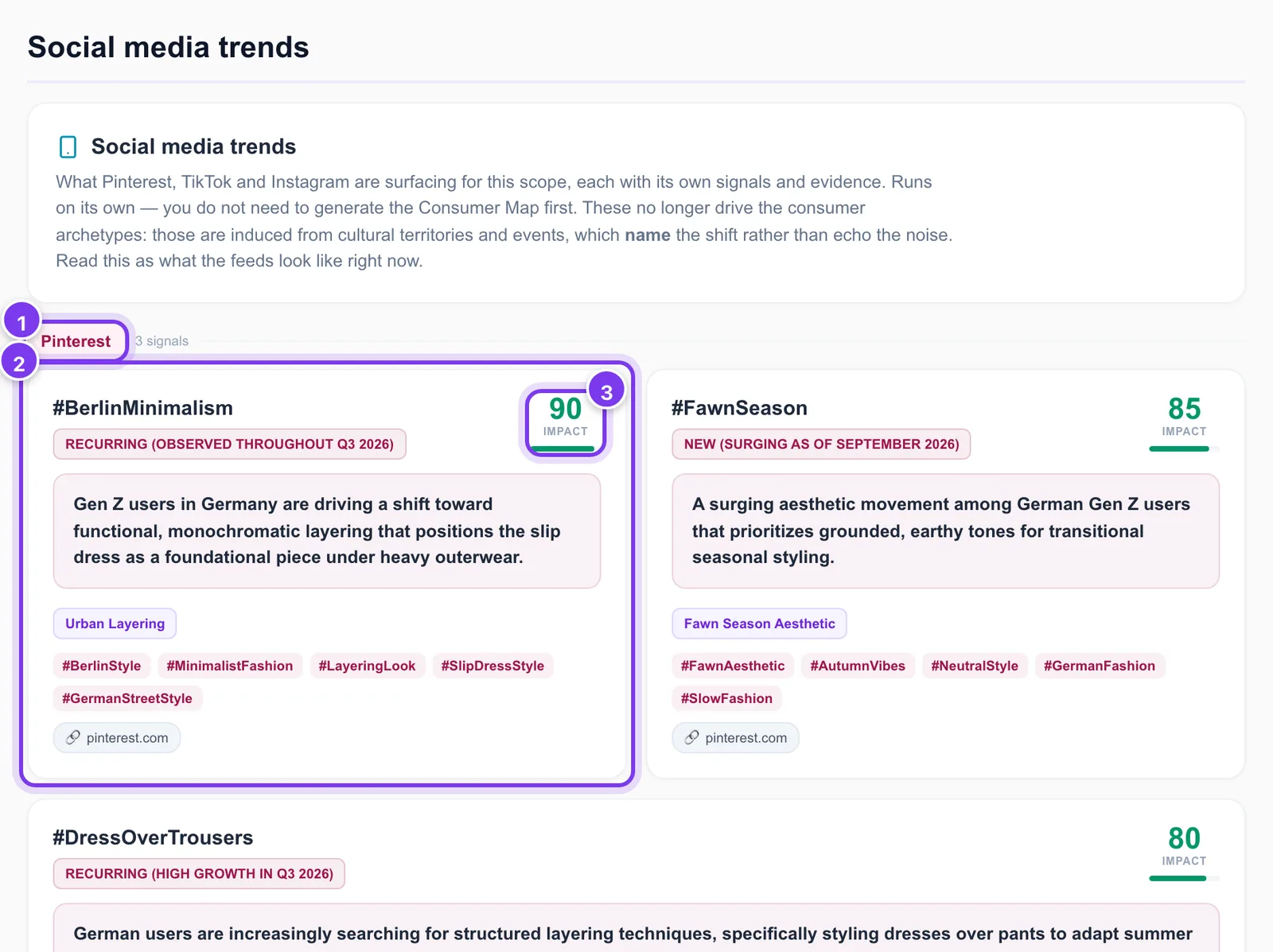
The Social media trends section with Pinterest trend cards such as #BerlinMinimalism, each with an impact score, tag, hashtags and source. Social media trends groups trends by platform. Each card names the trend, says whether it is recurring or new and since when, explains what consumers are doing, and lists the hashtags and source behind it. The tab runs on its own — it does not need the consumer map first.
- Platform — Pinterest, TikTok and Instagram each get their own group.
- Trend card — the behaviour, the hashtags carrying it and a source link.
- Impact score — how strongly the trend bears on this scope, out of 100.
Step 2: Separate recurring patterns from new spikes
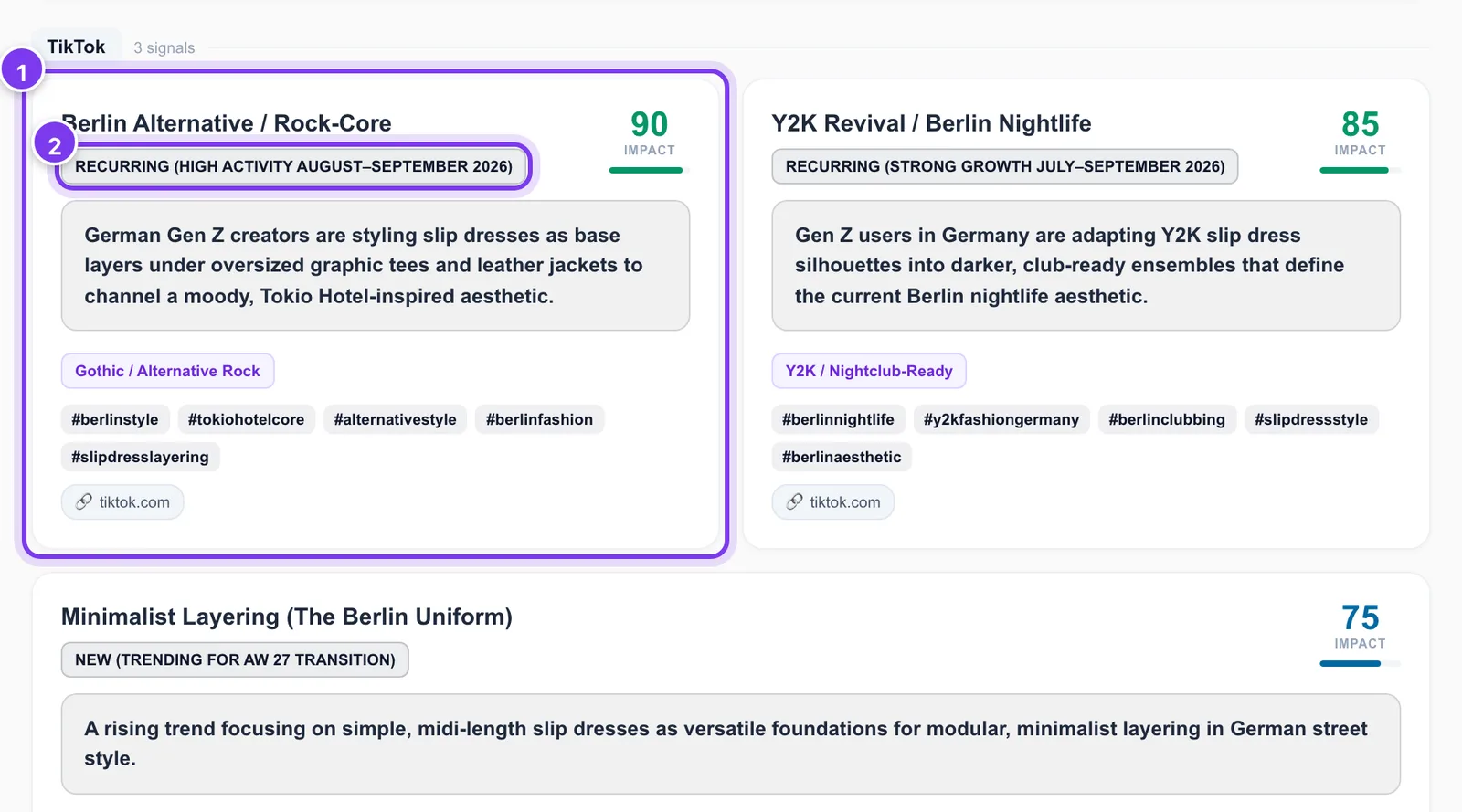
TikTok trend cards: Berlin Alternative / Rock-Core tagged recurring with high activity August–September 2026, and Y2K Revival / Berlin Nightlife. The tag under each title separates a recurring pattern — with the months it was most active — from a new one, so you can tell a dependable seasonal behaviour from a fresh spike.
- Trend card — here Berlin Alternative / Rock-Core, impact 90.
- Recurrence tag — recurring, with its period of high activity.
Step 3: Read street culture and subculture
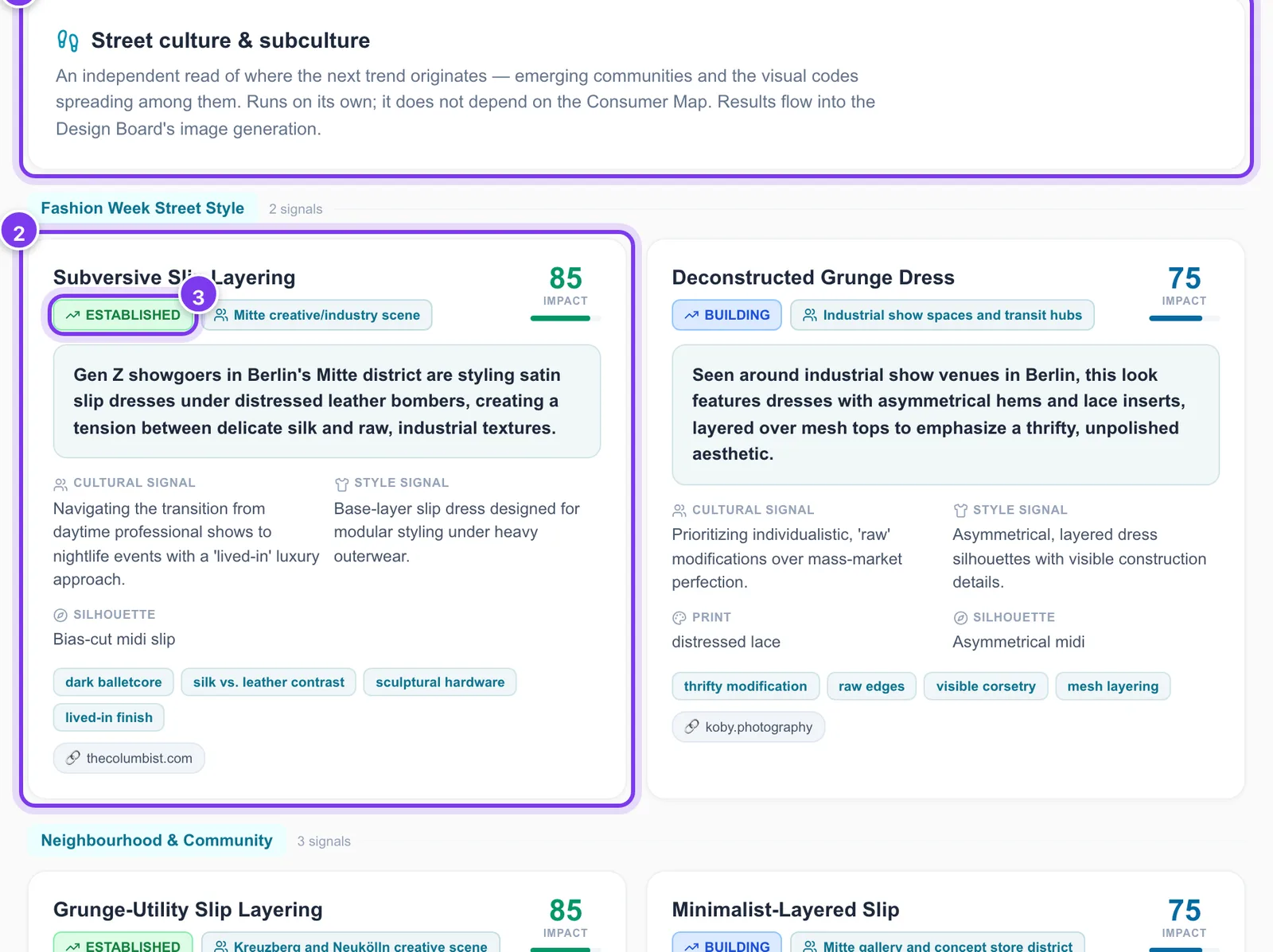
The Street culture & subculture section with street trend cards such as Subversive Slip Layering, marked Established in the Mitte creative scene. Street trends reads emerging communities and the visual codes spreading among them, grouped by where they come from — fashion-week street style, neighbourhood and community. Each card carries a stage, the scene it was seen in, the observed look, cultural and style signals, silhouette and keyword chips.
- What this lane is — an independent read that does not depend on the consumer map; its results flow into the Design Board.
- Street trend card — impact score, scene and the observed look.
- Stage — Emerging, Building or Established.
Step 4: Carry street cues into images with the brief
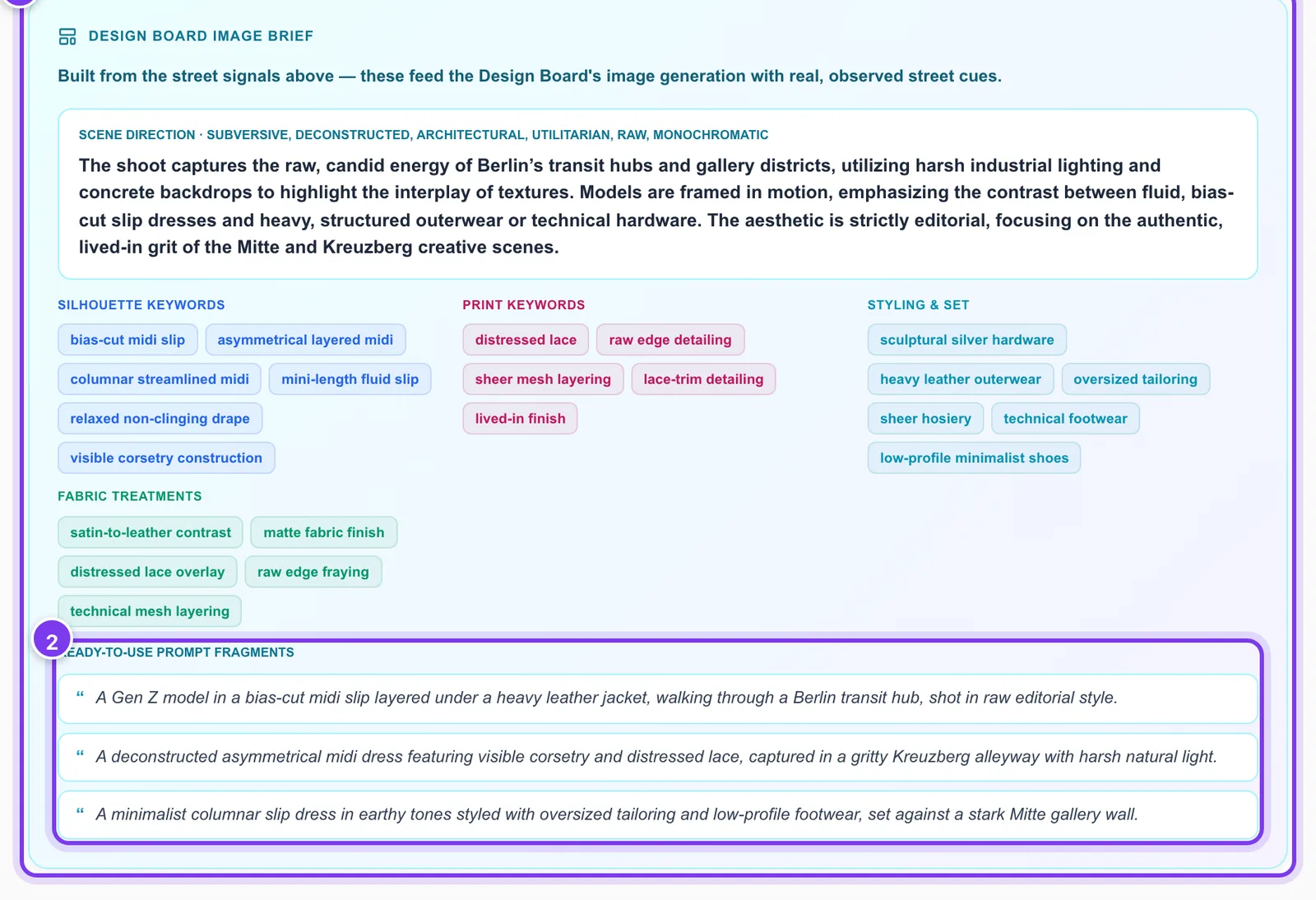
The Design board image brief built from street signals: scene direction, keyword groups and ready-to-use prompt fragments. Under the silhouette and print libraries, Design board image brief turns the street signals into a scene direction plus silhouette, print, styling and fabric-treatment keywords. The Design Board uses it, so generated visuals carry real, observed street cues rather than generic ones.
- Image brief — scene direction and keyword sets built from the street signals above.
- Prompt fragments — complete image prompts you can reuse.
What you have now
A clear read of what consumers are amplifying online and wearing on the street — and an image brief that carries those cues into the design board.
Frequently asked
Do I need to run the consumer map before social or street trends?
No. Social, street, material, narrative and catwalk lanes each run on their own. The consumer map and designer campaigns are the required inputs to the colour direction; the other lanes add evidence to it when they have run.
What does the impact score mean?
It rates how strongly a signal bears on your scope, out of 100. Use it to rank signals within a lane; it is a relevance score for this market and product, not a measure of global popularity.
Keep reading
How do I read the Consumer map in F-Predict?
The Consumer map shows which cultural territories are moving in your market and whether the runway agrees. Territories are sorted into Confirmed (in-market…
How do I read material and catwalk intelligence in F-Predict?
Material intelligence shows which textiles the trade shows are pushing for your scope and why each is emerging — its demand drivers, the consumer it serves…
What is trend acceleration?
Trend acceleration is the rate of change in a trend’s adoption — whether uptake is speeding up, holding steady or slowing down. It differs from popularity,…