
- Where
- Fashion Forecast → Consumer map tab
- Steps
- 5
- Time
- About 6 min
Before you start: A forecast with the consumer map run — see running your first forecast.
Step 1: Start with the cultural territories summary
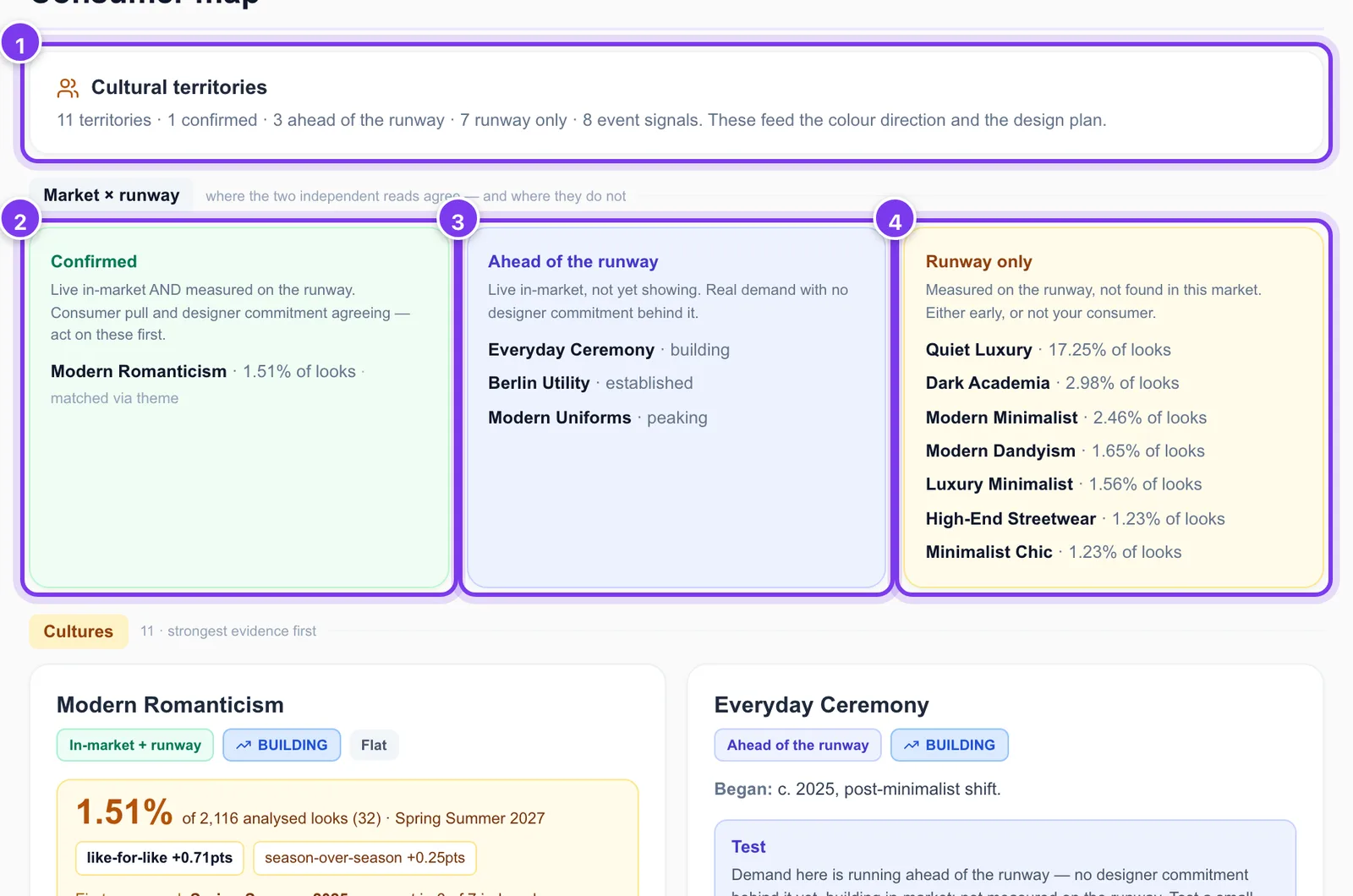
The Cultural territories summary and the Market × runway columns: Confirmed, Ahead of the runway and Runway only. The summary line counts what the run found — here 11 territories: 1 confirmed, 3 ahead of the runway, 7 runway only, plus 8 event signals. Market × runway below it places each territory where the two independent reads agree, and where they do not.
- Summary — territories found, how they split, and how many event signals feed the colour direction and design plan.
- Confirmed — live in-market and measured on the runway: consumer pull and designer commitment agree, so act on these first.
- Ahead of the runway — live in-market, not yet on the runway: real demand with no designer commitment behind it.
- Runway only — measured on the runway, not found in this market: either early, or not your consumer.
Step 2: Read a territory’s measured share and verdict
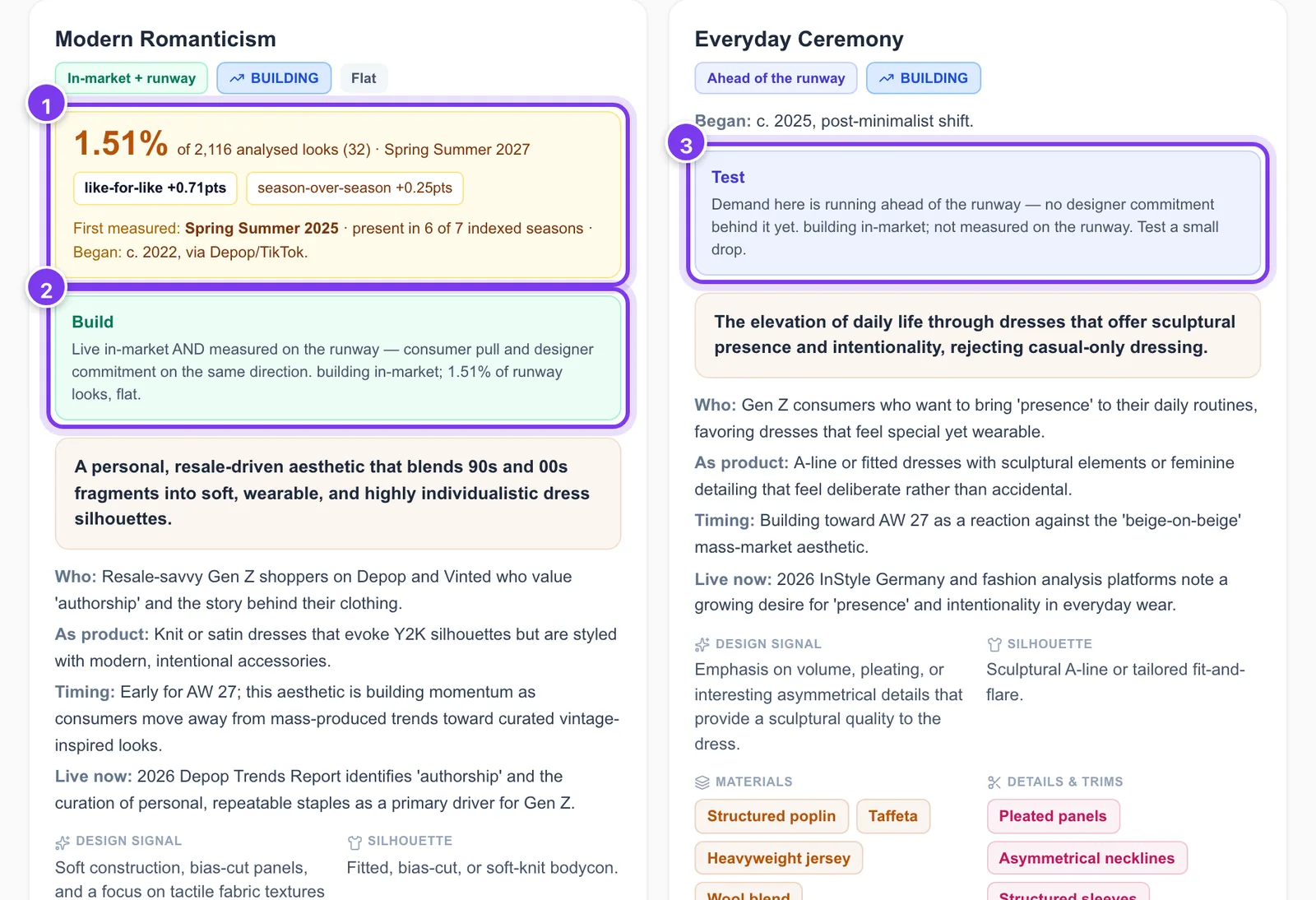
Two territory cards: Modern Romanticism with a 1.51% runway share and a Build verdict, and Everyday Ceremony with a Test verdict. Each territory card shows where it sits, its momentum (Building, Peaking, Flat) and a measured share of runway looks. Modern Romanticism is 1.51% of 2,116 analysed looks for Spring Summer 2027, up 0.71 points like-for-like and first measured in Spring Summer 2025. The verdict underneath tells you what to do about it.
- Measured share — percentage of analysed runway looks, with like-for-like and season-over-season change and when it was first measured.
- Build — in-market and on the runway in the same direction: commit development capacity.
- Test — demand running ahead of the runway with no designer commitment yet: test a small drop.
Step 3: Find the product opportunity
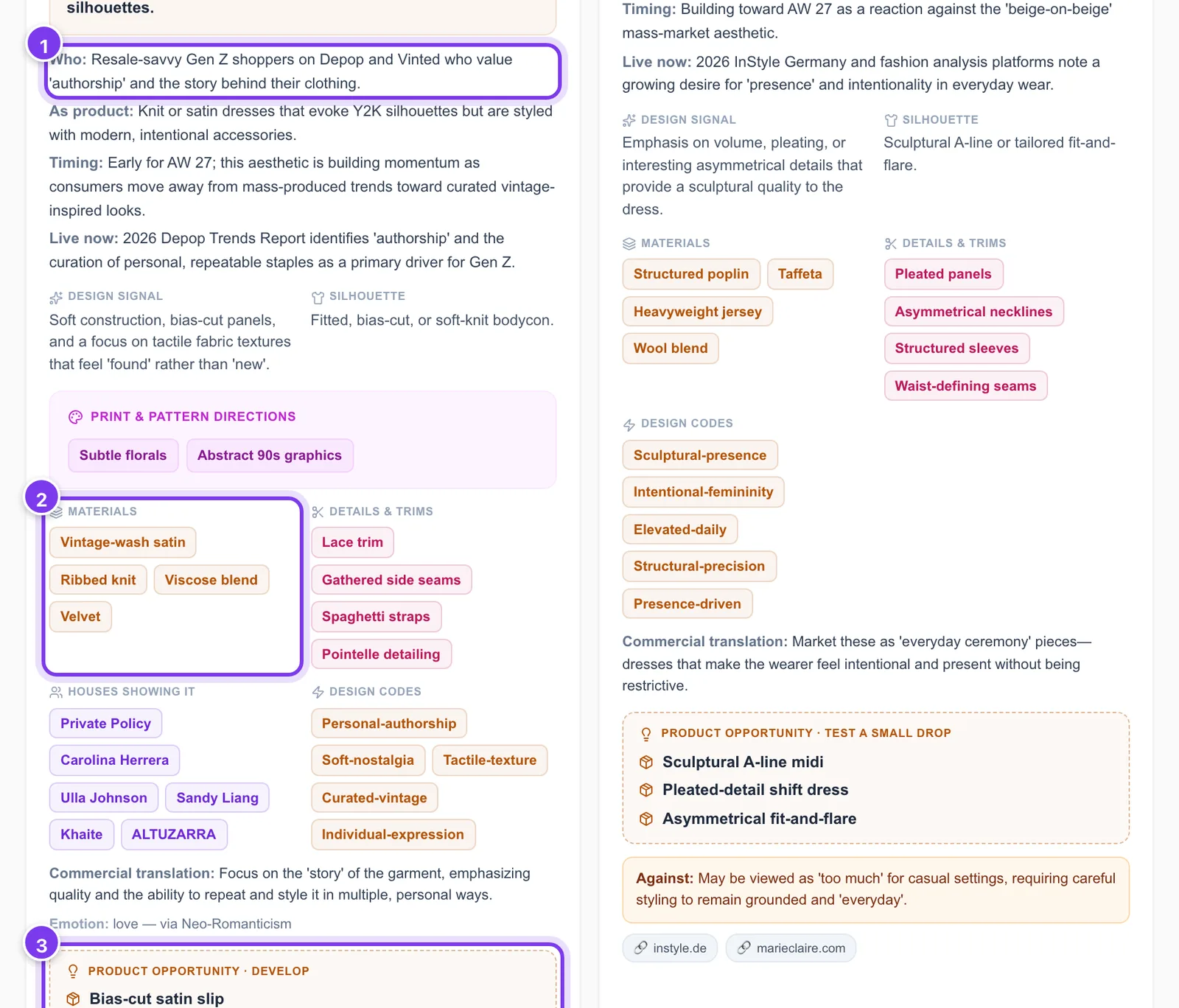
The detail of two territory cards: the Who, As product, Timing and Live now lines, materials and details chips, and the product opportunity list. Further down each card the territory becomes product: who is buying, what it looks like as product, timing and what is live now — then design signal, silhouette, materials, details and trims, design codes and the houses already showing it. Each card closes with concrete product opportunities and an Against note naming the risk.
- Who / As product / Timing / Live now — the consumer and the product reading in plain language.
- Materials — the materials the evidence ties to the territory.
- Product opportunity — specific garments to develop.
Step 4: Treat runway-only territories as a watch list
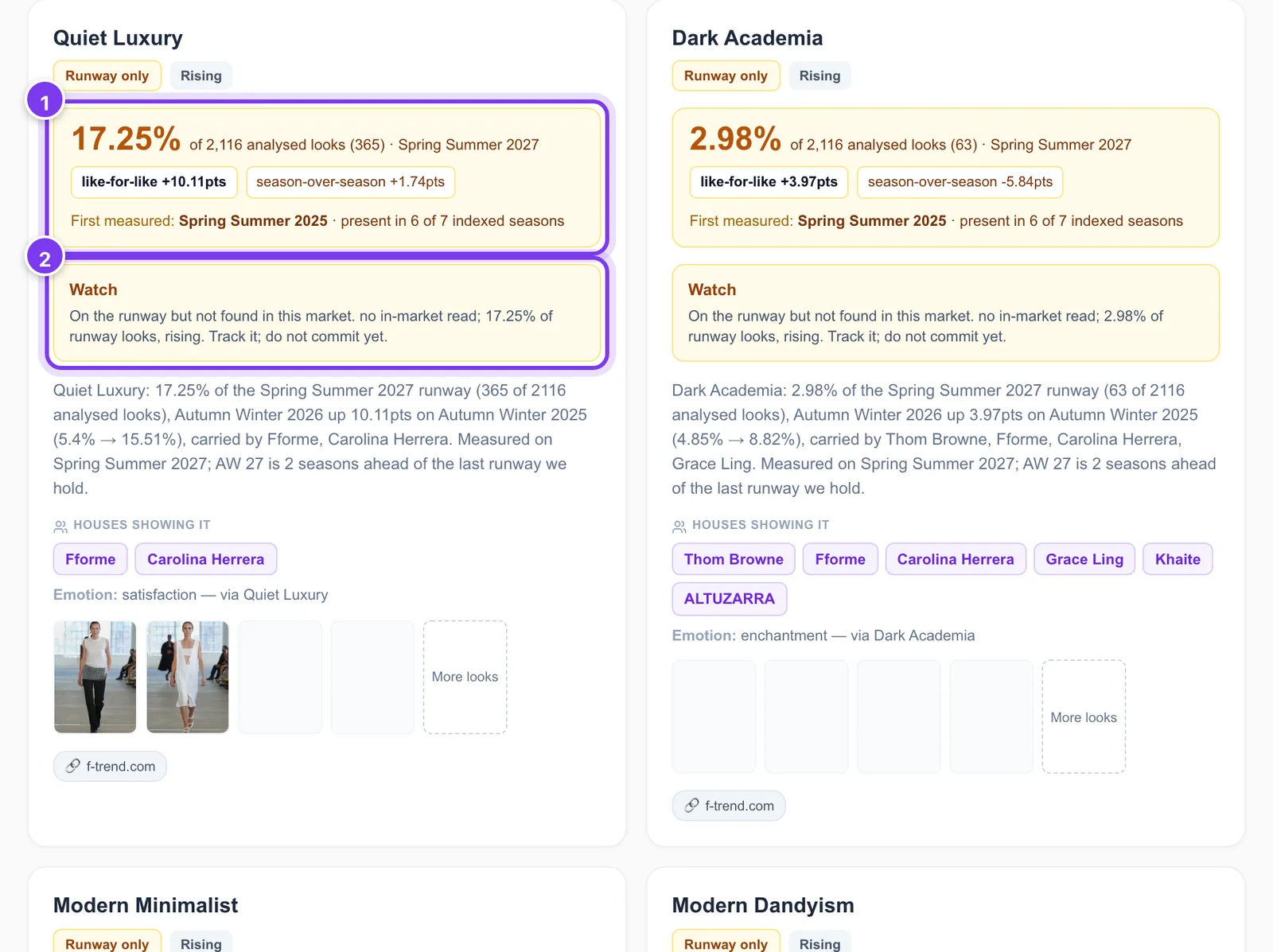
Runway-only territory cards for Quiet Luxury (17.25% of looks) and Dark Academia, each with a Watch verdict, houses and runway looks. A territory can be big on the catwalk and still absent from your market. Quiet Luxury is 17.25% of the Spring Summer 2027 runway, yet no in-market read was found for this scope — so the verdict is Watch: track it, do not commit yet. Houses showing it and sample runway looks are listed underneath.
- Runway share — large on the catwalk, measured the same way as every other territory.
- Watch — on the runway but not found in this market; track it rather than commit.
Step 5: Check the events feeding the map
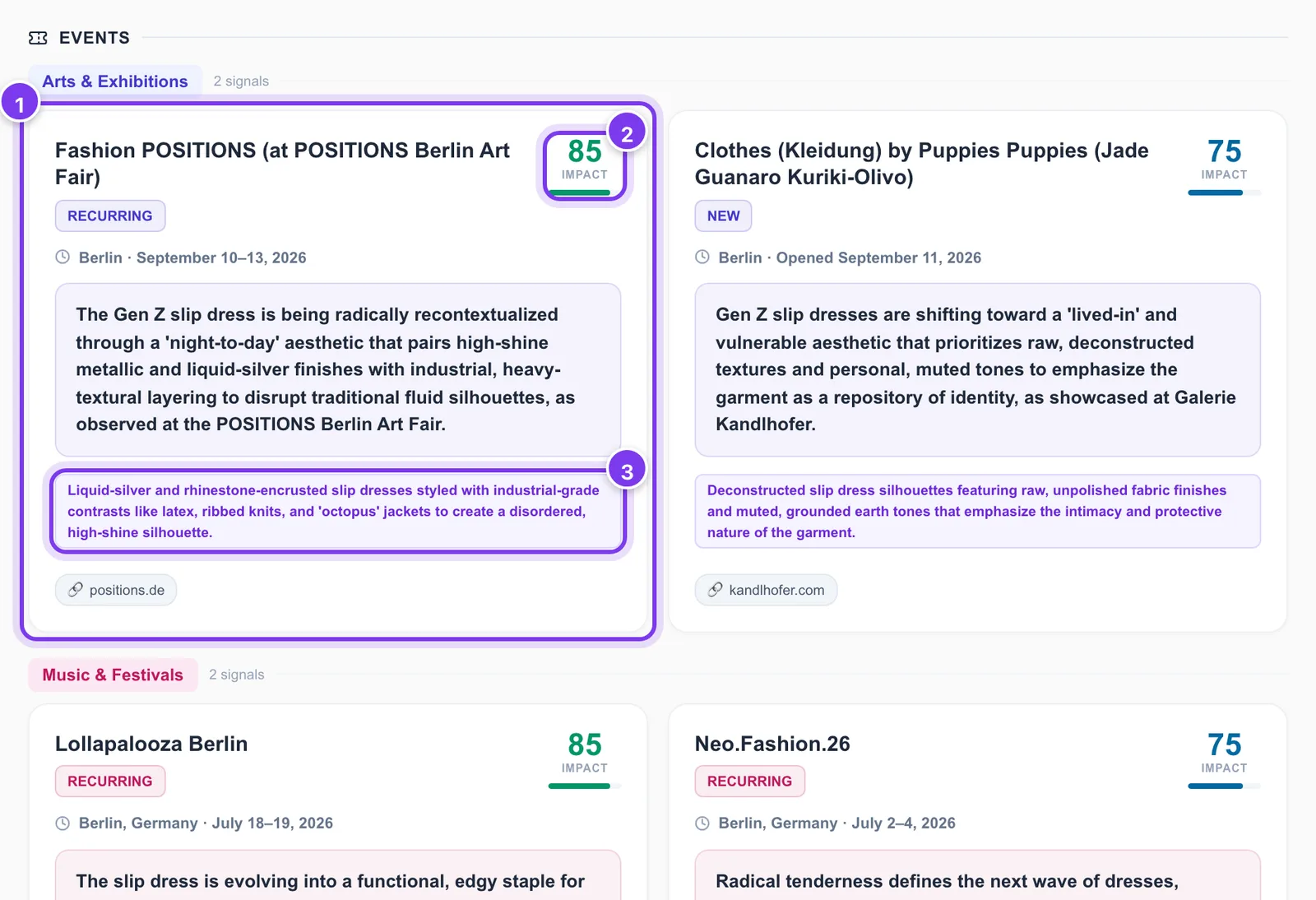
Event cards for Berlin, including Fashion POSITIONS with an impact score of 85, grouped under Arts & Exhibitions and Music & Festivals. Events lists the dated cultural moments inside your scope — exhibitions, festivals, fashion weeks, cultural and religious occasions — grouped by type and tagged recurring or new. Each one says what it means for the product.
- Event card — what is happening, where and when, and how it is shifting the product.
- Impact score — how strongly the event bears on this scope, out of 100.
- Product translation — the specific garment cues the event points to.
What you have now
A ranked view of which cultural territories to build, test or watch in your market — the base that the colour direction and design plan are built on.
Frequently asked
What is the difference between Build, Test and Watch?
Build means the territory is live in your market and measured on the runway in the same direction. Test means market demand is running ahead of the runway with no designer commitment yet — worth a small drop. Watch means it is on the runway but not found in your market — track it, do not commit.
Where does the runway share come from?
From F-Trend’s catwalk analysis. Each territory is measured as a share of analysed runway looks for the latest indexed season, with like-for-like and season-over-season change. A note under the map states the season, the look count and how many indexed seasons the measurement covers.
Keep reading
How do I run my first forecast in F-Predict?
Open F-Predict, choose Fashion Forecast and fill in Analysis Settings: season, market, region, consumer segment, garment category, subcategory and an optio…
What is trend adoption?
Trend adoption is the extent to which a trend has spread through a consumer population, described as a position on a curve running from innovators through…
How do you identify an emerging fashion trend?
An emerging fashion trend is identified by testing a signal against four conditions: it appears independently in unrelated domains, it has an identifiable…