Why Personality-Driven Fashion Trend Forecasting Will Replace Industry Consensus
December 26, 2025
12 min read
Fashion Intelligence
Article ID: 6526
The Illusion of Universal Trends in Fashion Forecasting
The fashion and consumer goods industries operate on a comfortable fiction: that global events push all consumers toward unified aesthetic responses. When the economy contracts, we're told everyone gravitates toward grey and muted tones. When political instability rises, militaryP²VP-inspired fashion allegedly dominates. When environmental consciousness peaks, sustainable minimalism becomes universal.
This narrative, perpetuated by influential forecasting organizations, has shaped billions of dollars in product development decisions for decades. Macro-environmental frameworks analyze conditions across Society, Technology, Economy, Politics, Industry, and Culture, then extrapolate singular aesthetic directions. The industry listens, coordinates, and manufactures accordingly.
But there's a fundamental problem with traditional trend forecasting methods: humans don't work this way.
The Real-World Problem: Immigration Tensions and Divergent Consumer Responses
Consider the current global dynamics around immigration and cultural identity. In countries like the USA, India, and the UK, tensions around migration and cultural preservation have intensified. Traditional macro-environmental forecasting frameworks would predict a uniform consumer response: everyone gravitates toward cultural protectionism, heritage aesthetics, and nationalist symbolism.
But observed reality reveals a fractured landscape. Within the same cities, consuming the same news, experiencing the same political shifts, two distinct personality clusters emerge with opposite aesthetic responses. Those with Nationalist personalities see immigration as a threat to cultural continuity. Their purpose activates around preservation and protection. They increasingly value cultural symbols, traditional colors rooted in their heritage, indigenous art forms, and films celebrating national identity. Product demand shifts toward heritage craftsmanship, culturally-specific textiles, and designs that signal belonging to their tradition.
Simultaneously, individuals with Globalist personalities experience the same events entirely differently. They view cultural mixing as enrichment rather than erosion. Their purpose activates around connection and exchange. They seek fusion aesthetics, globally-inspired design, multicultural pattern mixing, and art that bridges traditions. They consume films exploring cross-cultural narratives and purchase products that celebrate diversity and global citizenship.
Same stimulus. Same moment. Opposite responses. The divergence isn't demographic—you'll find both Nationalists and Globalists across age groups, income brackets, and geographies. The split is psychological, rooted in fundamental personality architecture that determines how external events get interpreted and translated into consumption behavior.
This article introduces F-trends' revolutionary P²VP framework—Personality to Purpose to Value to Product—as a more accurate, commercially viable, and intellectually honest approach to trend forecasting, marketing strategy, and product development.
The Fatal Flaw in Contemporary Fashion Forecasting Method
The dominant forecasting industry has built empires on systematizing trend observation. Global networks of scouts photograph street style, analysts monitor social media sentiment, databases archive decades of pattern recognition. The methodology sounds impressive—and it is, as an information aggregation machine.
But aggregation isn't insight. The framework's core assumption—that macro forces create unified directional pressure on consumer aesthetics—is demonstrably false. More troublingly, it's self-perpetuating. When industry authorities declare "terracotta is the color of the season," hundreds of brands produce terracotta collections. Retailers stock terracotta. Fashion media features terracotta. Consumers see terracotta everywhere and perceive it as "current." The prophecy fulfills itself not because consumers organically demanded terracotta, but because the industry coordinated around a shared forecast.
This creates market efficiency—supply chains align, inventory risk decreases, and marketing messages cohere. But it also creates market distortion. Brands lose differentiation, consumer choice narrows artificially, and genuine demand signals get drowned in manufactured consensus.
The Universal Color Fallacy in Trend Prediction
Annual color announcements have become cultural moments, covered by mainstream media as if revealing objective truths about collective consciousness. Color institutes analyze global events, cultural shifts, and cross-industry design movements to select single hues that "reflect the global zeitgeist."
The intellectual sleight of hand is subtle: they observe multiple trends, identify common threads, and declare a singular winner. But in doing so, they erase the psychological diversity that makes those multiple trends exist simultaneously in the first place.
Consider 2024's political landscape. In the United States, India, and the United Kingdom, nationalist movements gained momentum alongside rising immigration tensions. Traditional forecasting might conclude: "Consumers will embrace heritage aesthetics universally." But observed reality was more complex.
Those with Nationalist personalities did embrace heritage—activated by perceived threats to cultural continuity, they sought traditional textiles, culturally-specific colors, indigenous art forms, and films celebrating national identity. Simultaneously, consumers with Globalist personalities reacted with cosmopolitan assertion, seeking fusion aesthetics, globally-inspired design, and art bridging cultural boundaries. Still others with Nurturer personalities withdrew from political symbolism entirely, retreating into comfort and personal sanctuary regardless of cultural debates.
All three responses coexisted in the same markets, at the same time, driven by the same events. A monolithic forecast captures none of this nuance.
F-trends' P²VP Framework: The Future of Fashion Forecasting
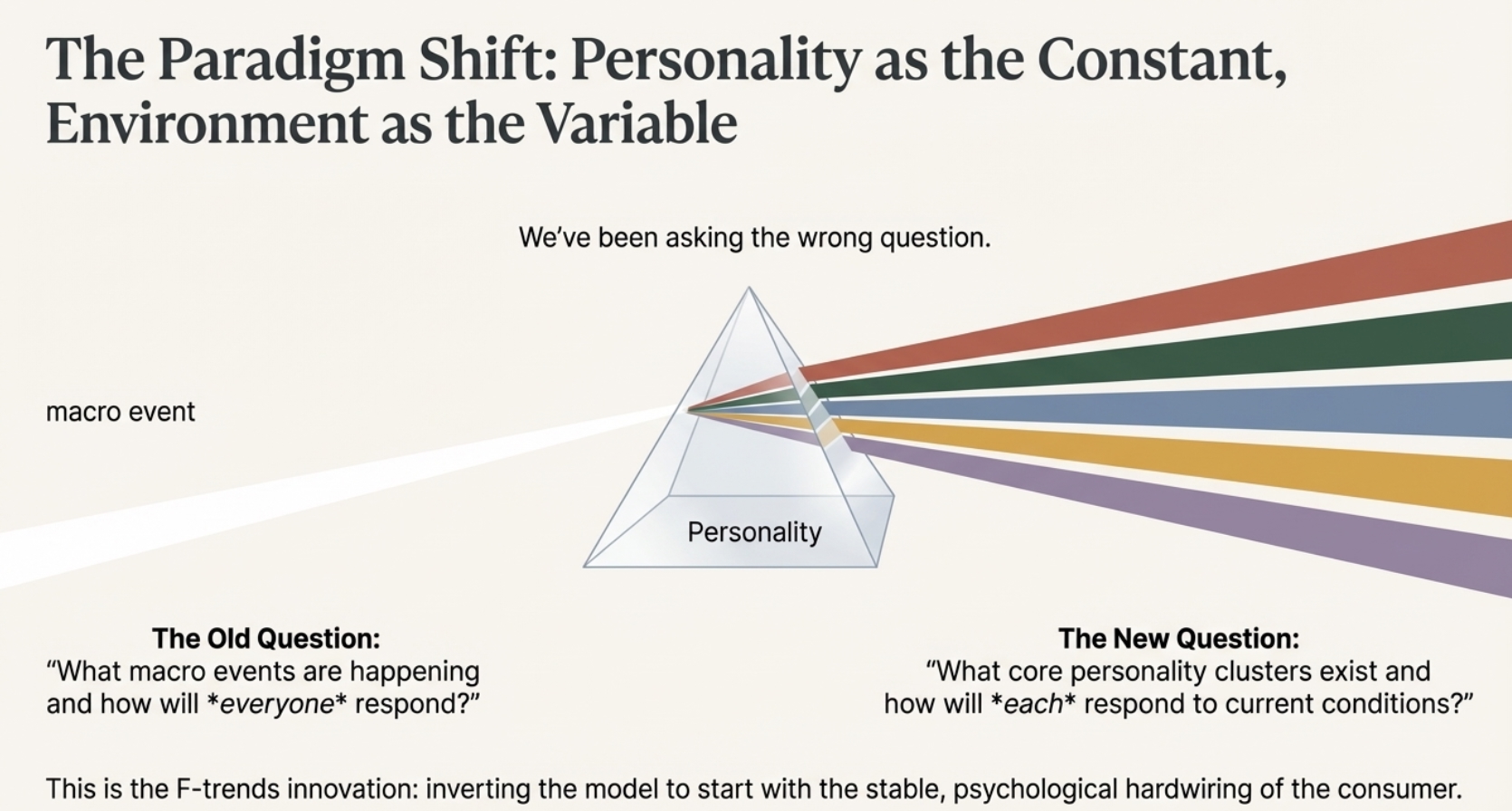
The Core Innovation: Personality as Constant, Environment as Variable
F-trends' P²VP methodology inverts traditional forecasting logic. Instead of asking "What macro events are occurring and how will everyone respond?" the P²VP framework asks "What personality clusters exist in the population, and how will each respond to current conditions?"
Personality: The biological and psychological hardwiring that remains relatively stable throughout adult life. These aren't demographic categories—a 25-year-old urbanite and a 55-year-old rural resident might share the same core personality.
Purpose: The "why" that emerges from personality. A Preservationist personality naturally orients toward purposes of cultural continuity, legacy building, and heritage protection.
Value: The ethical and aesthetic filter through which purpose manifests. Preservationists value durability, authenticity, and tradition over novelty and trend-cycling.
Product: The tangible outcome. A Preservationist doesn't want "this season's trendy pink bomber jacket"—they want "a timeless wool coat using traditional tailoring methods that will last decades."
Consumer Personality Taxonomy: Foundation of the P²VP Method
The F-trends framework requires a robust taxonomy of core personalities. While the exact number is debatable (Myers-Briggs uses 16, Big Five uses 5 dimensions), the principle remains: consumers cluster into psychologically coherent groups that respond predictably to their environment.
Consider these illustrative personalities in F-trends' system:
The Preservationist (15-25% of most populations): Values tradition, continuity, and cultural belonging. Seeks authenticity and heritage. In times of change, doubles down on roots and proven systems.
The Experimentalist (10-18% of populations): Thrives on novelty, risk, and boundary-pushing. Seeks unique experiences and first-mover status. In times of stability, gets bored; in chaos, sees opportunity.
The Nurturer (18-28% of populations): Prioritizes care, comfort, and emotional wellbeing. Seeks harmony and safety. In times of stress, creates sanctuary; in times of abundance, extends care outward.
The Individualist (12-20% of populations): Values self-expression and autonomy. Seeks differentiation and personal narrative. In times of conformity pressure, rebels; in times of freedom, explores identity.
The Pragmatist (20-30% of populations): Values functionality and efficiency. Seeks solutions over aesthetics. In times of uncertainty, focuses on practical preparedness; in stability, optimizes systems.
These aren't exhaustive, but they illustrate the F-trends principle: distinct psychological profiles that filter the same environmental stimuli through different purpose lenses, generating different value systems and product demands.
Measuring Personality Distribution: From Theory to Actionable Data
The F-trends P²VP framework's commercial viability depends on measuring personality distribution accurately. Several methodologies converge:
Consumption pattern analysis: Purchase behavior reveals personality. Preservationists buy vintage, repair services, and heritage brands. Experimentalists buy limited editions, new brands, and unconventional items. Analyzing retail data across categories can estimate personality prevalence.
Social media sentiment: The language people use online signals personality. Preservationists use words like "timeless," "authentic," "heritage." Experimentalists use "never seen," "groundbreaking," "exclusive." Natural language processing can map these patterns at scale.
Survey instrumentation: Direct personality assessment through psychographic surveys, distributed through retail partners, social platforms, or market research firms.
Cultural indicator tracking: Media consumption patterns, political engagement, entertainment preferences—all correlate with personality types and can be tracked through public data.
The key insight in F-trends methodology: you don't need perfect precision. You need directional accuracy about which personalities are growing or shrinking in market share, and by roughly how much.
Operational Application: Forecasting, Marketing Strategy, and Product Development
Fashion Trend Forecasting: Tracking the Dominant Personality
Traditional trend forecasting asks: "What color will trend?" F-trends' P²VP asks: "Which personality is ascending this season, and what will they demand?"
Example: Q1 2025 Consumer Trend Analysis
Political instability in major markets (US political transition, European economic uncertainty, Middle East conflict) creates collective anxiety. Traditional forecast: "Muted colors, comfort-focused design, risk-averse consumption."
F-trends P²VP analysis reveals:
Preservationist personality growing from 22% to 29% (activated by change anxiety)
Nurturer personality stable at 25% (ongoing wellness trend)
Experimentalist personality declining from 16% to 12% (risk appetite suppressed)
Individualist personality growing from 14% to 17% (reaction against conformity pressure)
Trend forecast implication: Two dominant opportunities exist—Preservationist (largest and growing) and Individualist (smaller but ascending). Experimentalist offerings will underperform.
Notice what F-trends doesn't predict: a single "trend." The P²VP framework predicts multiple concurrent opportunities of different sizes, allowing brands to choose their battleground strategically.
Marketing Strategy: Personality-Based Campaign Development
Demographics are dead in modern marketing. A 28-year-old Preservationist has more in common with a 52-year-old Preservationist than with a 28-year-old Experimentalist. F-trends' marketing approach targets psychological profiles, not age brackets.
Preservationist Marketing Campaign Architecture:
Messaging: "Built to last generations" / "Rooted in tradition" / "Crafted with integrity"
Influencers: Provocateurs, emerging artists, early adopters, boundary-pushers
Tone: Confident, disruptive, exclusive, immediate
Same product, completely different framing, each authentic to its target personality.
The efficiency gain is profound using F-trends methodology. Instead of broadcasting generic "this season's collection" messaging hoping to capture everyone, you create personality-specific campaigns that resonate deeply with their targets. Conversion rates increase because the message aligns with core psychological drivers, not superficial demographic assumptions.
Product Development Strategy: Designing for Psychological Need
F-trends' P²VP revolutionizes product development by replacing "What's trending?" with "Which personality are we serving, and what does their purpose demand?"
Traditional product development approach:
Observe trend reports
Design 100 SKUs covering various "trends"
Hope something resonates
Accept 60-70% markdown rates
F-trends P²VP approach:
Identify target personality (brand DNA-aligned)
Map their current purpose activation (what's motivating them this season)
Translate purpose through their value system
Design product that authentically serves that personality
Example: Brand Strategy Decision Using P²VP
A mid-market apparel brand must decide its Spring/Summer 2026 direction. Market analysis using F-trends methodology shows:
Preservationist: 26% of market (stable)
Nurturer: 24% of market (growing)
Experimentalist: 14% of market (shrinking)
Individualist: 18% of market (growing)
Pragmatist: 18% of market (stable)
Option A: Chase the largest segment (Preservationist)
Develop heritage-inspired collection
Natural fibers, classic cuts, earth tones
"Timeless investment" positioning
Risk: crowded space, requires authenticity
Option B: Target the growth segment (Nurturer)
Develop comfort-focused collection
Soft textures, relaxed fits, calming palette
"Sanctuary" positioning
Risk: trend may be peaking
Option C: Own a niche (Individualist)
Develop customization platform
Modular pieces, artisan collaborations
"Your story, your style" positioning
Risk: smaller market, higher margin required
Each strategy is valid. F-trends' P²VP doesn't prescribe which to choose—it reveals the options clearly, with market sizing, so brands can make strategic decisions aligned with their capabilities and DNA.
Why F-trends' P²VP Framework Will Dominate Fashion Forecasting
Intellectual Honesty in Trend Analysis
F-trends' P²VP doesn't claim to predict a singular future. It maps a psychological landscape and tracks how different regions of that landscape activate under various conditions. This is epistemically honest—it acknowledges human diversity rather than papering over it with false consensus.
Commercial Viability and ROI
Brands don't need everyone to buy their product. They need enough of the right people to buy profitably. F-trends' methodology enables precise targeting of personality segments most aligned with brand positioning, increasing conversion efficiency and reducing waste.
Competitive Differentiation in Saturated Markets
When every brand follows the same industry forecasts, differentiation collapses. When brands target different personalities authentically using F-trends' approach, they occupy distinct market positions. Five brands can coexist profitably serving five different personalities, all thriving in the same season.
Reduced Waste and Improved Sustainability
Overproduction stems from uncertainty. When brands hedge by producing "everything that might trend," inventory balloons and markdowns follow. F-trends' personality-driven product development reduces SKU proliferation and increases sell-through by focusing on psychologically-coherent offerings.
Long-Term Brand Building and Customer Loyalty
Trend-chasing creates identity crisis. A brand that pivots aesthetically every season builds no equity. A brand that consistently serves a specific personality—outdoor brands for Nationalists who value cultural legacy and connection to land, streetwear labels for Experimentalists who crave cultural disruption—builds deep loyalty within its psychological tribe using F-trends principles.
The Path Forward: Implementing Personality-Driven Forecasting
The transition from monolithic forecasting to personality-driven strategy won't happen overnight. Established forecasting organizations have decades of entrenchment, color authorities have cultural cachet, and industry coordination has real efficiency benefits. But the cracks are showing.
Consumers increasingly reject manufactured consensus. The explosion of niche brands, the fragmentation of media, the rise of hyper-targeted digital marketing—all signal that the era of universal trends is ending. The internet didn't create a global monoculture; it revealed and empowered infinite subcultures.
Brands that adopt F-trends' P²VP framework early will gain disproportionate advantage. Those that continue chasing monolithic "trends" will find themselves in perpetual markdown cycles, confused by why their forecasted collection isn't selling despite industry blessing.
The future of fashion forecasting isn't predicting what everyone will want. It's understanding what distinct groups of people will always want, and tracking when those groups grow or shrink in market influence. It's replacing the comfortable fiction of universal trends with the uncomfortable truth of psychological diversity.
Conclusion: The Personality Revolution in Fashion
I
t's time to move beyond the monolith. The market is ready. The data exists. F-trends' framework works. What remains is the courage to abandon the old religion of industry consensus and embrace the science of human psychological architecture.
The question isn't whether personality-driven forecasting will replace environmental monoliths. The question is which brands will adopt F-trends' P²VP methodology first, and reap the advantage of authenticity in a fragmented world desperate for it.
Ready to transform your trend forecasting and product development strategy? Discover how F-trends' P²VP framework can revolutionize your brand's approach to consumer behavior analysis and marketing effectiveness.
About F-trends: F-trends pioneered the P²VP (Personality to Purpose to Value to Product) methodology, revolutionizing how brands approach trend forecasting, marketing strategy, and product development through personality-driven consumer analysis.