
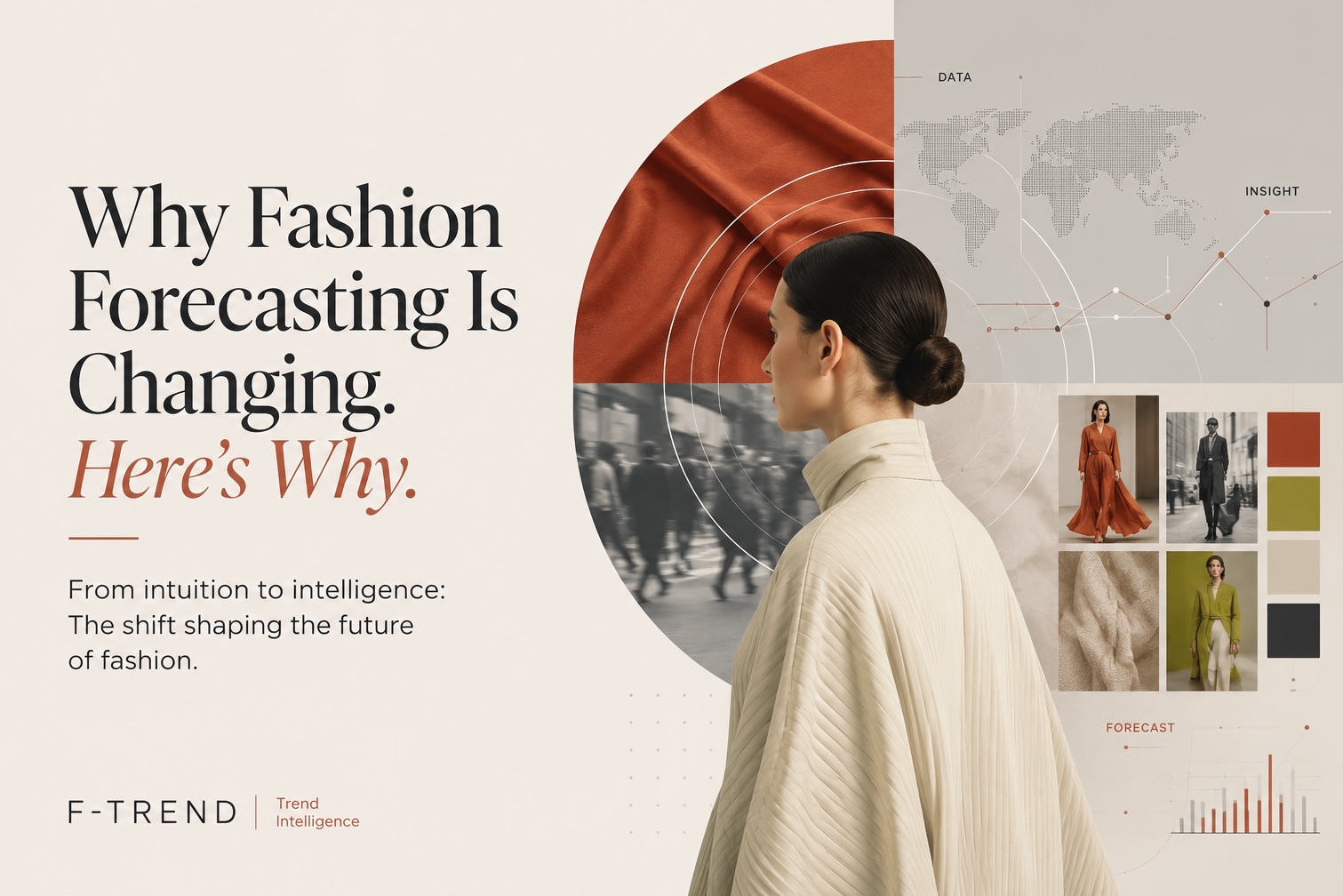
Fashion forecasting
is changing. Here's why.
A trend book updates two to four times a year. The market it describes now updates weekly. This is the gap driving the shift in forecasting — and what's closing it.
- Seasonal reports update a handful of times a year. Product is now launching weekly, sometimes faster.
- Style, material, and cultural narrative move faster than any printed report can capture.
- Continuous intelligence isn't an upgrade to forecasting — it's becoming the baseline requirement.
Anyone working in product development has felt this: a report arrives, and before it's even been fully read, part of it is already out of date. That isn't a criticism of the people who wrote it. It's a structural problem — one built into the format itself, and worth understanding properly before looking at what replaces it.
There was a time this made perfect sense.
Go back twenty years and the path a trend took to reach a rack was simple enough to recite from memory.
–2010
This worked, and worked well, because the pace of the format matched the pace of the world. Fashion cycles ran long. Nothing was pushing new references into anyone's pocket every hour. Consumer taste shifted the way a season turns — gradually, and mostly in one direction at a time.
–2020
Then the number of places a trend could originate from stopped being small. Culture began arriving from everywhere, continuously — and a system designed to check in once a season was suddenly expected to track something that never stopped moving.
Which is the situation now. It's worth being precise about what that means: a trend book published once a season cannot update every week. That isn't a matter of the team behind it working harder. The format has a structural ceiling, and the market has moved past it.
Static reports. A market that no longer holds still.
A traditional trend book is static by design. It's researched, written, and published — and from that point forward, it's finished. Whatever was true the week it went to print is what it says, unchanged, until the next edition arrives months later. That isn't a flaw in execution. It's simply what a printed document is, once the file is closed.
Meanwhile, look at how brands are actually operating. Product isn't launching four times a year anymore — it's launching weekly, and for a growing number of brands, faster than that. Fast-fashion retailers treat weekly drops as a baseline. Direct-to-consumer brands test and release in near-continuous cycles. Even brands still built around two seasonal shows are making dozens of smaller commercial calls in between — reorders, restocks, capsule releases — and every one of those calls needs current information, not a snapshot from four months ago.
That's the actual mismatch: a document accurate for one moment, going stale the day after it's published, on one side — a business making decisions every week, on the other.
What closing that gap actually requires
If product moves weekly, intelligence has to move weekly too — and across more than one axis at once. Not only "what's the trend," but a continuous read across everything that feeds a commercial decision. We think of it as six connected signals.
Not a seasonal survey. An ongoing read of what people are actually buying, saving, and abandoning, updated as their behaviour updates.
Which categories and silhouettes are gaining real commercial traction this week, and which are losing it, before that shows up in a markdown.
The small, continuous shifts in proportion and styling that move faster than any seasonal theme and are easy to miss between two annual check-ins.
Fabric and texture demand respond to culture in real time — a film, a celebrity moment, a sustainability story — faster than a static report can react.
What's actually being worn, versus what was aspirational on a runway six months ago. The gap between the two is usually where the commercial signal lives.
The story behind the trend — why it's resonating, what's fuelling it, whether that moment is building or already fading. Miss this, and you invest in the image without seeing the current pulling it along.
None of this is supplementary to forecasting. It's the baseline now. Intelligence that only refreshes once a season isn't a smaller version of what's needed — it's answering a different question than the one the market is currently asking.
The gap isn't only about speed.
Global direction, local reality
Most reports speak in one voice for the whole world. What sells in Seoul isn't what sells in São Paulo — a single global narrative was never built to carry that kind of nuance, however well it's written.
Inspiration isn't a decision
A report tells you what's happening. It rarely tells you the harder thing needed before real money moves: should you invest in this, or not? That gap, between information and decision, is where budget quietly gets wasted.
The blank-page problem
Even after the report is read, someone still has to start from nothing — build the moodboard, choose the colours, sketch the print, alone. Insight and creation sit in two separate rooms, and someone has to carry the idea between them by hand, every time.
The runway isn't the whole conversation
Fashion is written as much by film, gaming, music, street culture, and consumer narrative as by any catwalk. A system that only listens to the runway is only hearing part of the conversation — and increasingly, not the loudest part.
So we stopped asking how to publish faster.
We asked something else: what if every one of these signals — consumer behaviour, product direction, style, material, street, narrative — lived inside one continuous system, instead of one static document? Not a snapshot. A system that keeps watching, connecting, and translating, all the way through to the product itself.
Follow that chain end to end, and the gap in the old model becomes hard to unsee: it stops at the report. This one keeps running, week after week, in step with the business it's actually serving.
Put the two side by side, and let the shape speak for itself.
| Traditional | Predictive |
|---|---|
| Seasonal reports | Continuous intelligence |
| Static documents | Live platform |
| Global direction | Local & contextual insight |
| Trend inspiration | Decision intelligence |
| Manual design translation | AI-assisted creative development |
| One-way reports | Interactive exploration |
| Designer interprets alone | Platform assists product development |
That isn't a hypothetical. It's the operating standard forecasting is moving toward, and the brands who adopt it first will simply be reacting to the market as it exists. Everyone else will keep reacting to the market as it existed last season.
Fashion forecasting isn't disappearing. It's evolving — from something consulted once a season into something that runs continuously beside the business itself, tracking consumer behaviour, product direction, style, material, street, and narrative in step with a market that now moves weekly.
Traditional forecasting was built to answer one question: what are the trends? F-predict exists to answer a harder one: what cultural changes actually matter, why are they emerging, and how do they become commercially actionable product development — this week, not next season?
That's not a faster version of the same answer. It's a different question, built for the pace the industry is already operating at.