
The industry spends billions on trend research, colour forecasting, and consumer data. And yet collections still miss. Customers still disengage. Brands still wonder why a product that looked right on paper feels completely wrong in the hands of the person it was made for. The answer has been hiding in plain sight — and F-Trend's HPEI methodology is the first framework to make it actionable.
There is a moment every fashion designer knows. You have spent months on a collection. The fabrics are right. The silhouettes are refined. The colour story is coherent. The mood board is beautiful. And then the collection lands — in stores, on the runway, in the market — and something is off. Not wrong, exactly. Just... not connecting. Customers look but do not touch. They touch but do not buy. They buy but do not wear. And no amount of data analysis seems to explain the gap between what you built and what the person standing in front of it actually feels.
That feeling is not a creative failure. It is a methodology failure. And it is more common than the industry admits.
At F-Trend Academy, we have spent years researching why this gap exists — and building a framework precise enough to close it. The framework is called HPEI: Human Product Emotion Interaction. It is the centrepiece of F-Trend TrendClass, our applied design psychology methodology. And it starts with a truth that the fashion industry has known intuitively for decades but has never had the language to act on: customers do not buy products. They buy emotional experiences — and when the product fails to deliver the right experience for the right person, no amount of visual beauty saves it.
|
|
|
|
The Problem: Fashion Forecasting Describes the Past, Not the Future
Here is a sentence from F-Trend's research that stops most designers cold: fashion forecasting has a persistent and well-documented failure mode — it is extraordinarily good at describing what has already happened and surprisingly poor at predicting what will happen next. The root cause is not inadequate data. The modern fashion industry has more consumer data than it can process. The root cause is a systematic underinvestment in the science of why consumers make the choices they make. Without understanding the psychological and emotional mechanisms that drive desire, data is a description of the past, not a map of the future.
|
|
Think about the last time you saw a collection that felt technically correct — beautiful fabrication, coherent aesthetic, strong brand identity — and yet somehow failed to generate desire. The silhouettes were well-proportioned. The colour story was logical. The styling was considered. And yet customers walked past it. Nothing was wrong. Everything was missing.
This is what F-Trend calls the emotional gap: the distance between the aesthetic intention of the designer and the emotional experience of the consumer. And it exists because most fashion design briefs specify what a product should look like, and almost never specify what it should make the person wearing it feel. The F-Trend HPEI methodology was built precisely to close that gap — by making emotion the specification, not the afterthought.
The three most common emotional misses in fashion design — and why they happen
Miss 01: Designing for aesthetic preference instead of emotional outcome. A designer creates a piece they find beautiful. The target consumer has a completely different emotional profile — their P²VP persona, in F-Trend TrendClass language — and experiences the piece as cold, aggressive, or irrelevant. The product is not wrong for everyone. It is wrong for the specific person it was made for. This is the most common miss in fashion, and the most preventable.
Miss 02: Using vague emotional language in the design brief. 'Make it feel powerful.' 'Make it feel luxurious.' 'Make it feel feminine.' These are not design specifications. They are emotional fog — words that mean entirely different things to different designers, different consumers, and different cultural contexts. Without the precision of the F-Trend PEG Filter — which translates vague intent into a single named emotion from a precise 25-emotion typology — the brief is open to interpretation at every stage, and the emotional signal degrades with every handoff.
Miss 03: Treating the tactual experience as secondary to the visual. Fashion photography and social media have trained the industry to optimise for how a product looks on a screen. But the consumer's purchase decision — and, more importantly, their loyalty decision — is made at the moment of touch. The fabric's weight in the hand. The surface finish under the fingers. The way the garment moves when worn. These are HPEI Tactual dimension decisions, and in the F-Trend HPEI methodology, they are given equal specification weight to colour and silhouette. A product that looks like Serenity but feels like nothing has already failed before the customer reaches the checkout.
|
|
|
|
The First Fix: Stop Guessing at Emotion — Start Mapping It
The first tool in the F-Trend HPEI methodology is the Emotion Index Circumplex — a framework drawn from Mehrabian and Russell's landmark 1974 research on environmental psychology and developed by F-Trend into a practical design instrument for fashion and product development. The Emotion Index maps every emotional experience on two axes: Arousal — how energised or calm the experience makes the consumer feel — and Pleasure — how positively or negatively the emotion registers. Every product you have ever designed sits somewhere on this map. The F-Trend Emotion Index makes that position intentional.
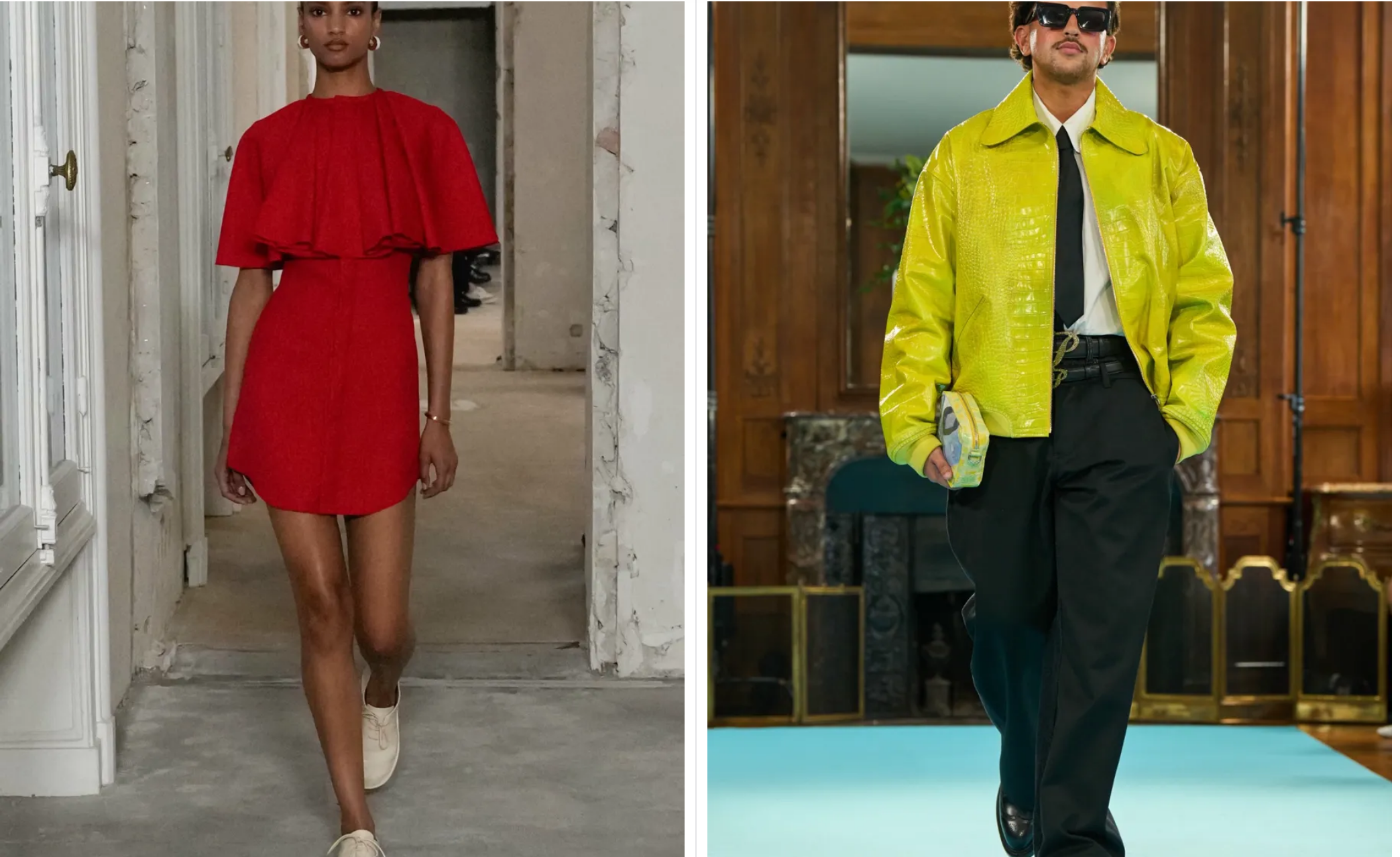
Consider two products in the same category: a scarlet red cape-collar mini dress and an acid-lime crocodile-embossed bomber jacket. Both are high-arousal, high-pleasure products on the F-Trend Emotion Index — but they occupy different emotional positions. The red dress targets Passion: High Arousal + High Pleasure — sensuality, spectacle, desire. The lime bomber targets Pride / Courage: High Arousal + Pleasure-Tension — exhibition, rebellion, confrontational confidence. Both are visually exciting. But they are not interchangeable. A consumer whose Emotion Index need is Passion will not connect with the bomber's Pride register, no matter how technically accomplished it is. And a consumer whose need is Pride will find the dress's Passion register too soft, too yielding, too concerned with desire rather than declaration.
This is the insight that changes everything when designers first encounter the F-Trend Emotion Index: the emotional position of a product is not a by-product of its aesthetics — it is its primary specification. Colour, silhouette, fabric, embellishment are all delivery mechanisms. The F-Trend Emotion Index is the target they must deliver to. A saturated red that delivers Passion is a completely different design brief from a saturated red that delivers Courage — and without the Emotion Index to distinguish between them, the designer is making intuitive guesses where they could be making calibrated decisions.
|
|
The practical power of the F-Trend Emotion Index in fashion design is this: it creates a shared emotional language across the entire design and development process. The designer, the buyer, the merchandiser, the copywriter, and the retail team are all aligned on the same emotional coordinate — because the coordinate is named, visible, and measurable. When a design review asks 'does this fabric choice support our Emotion Index position of Passion?' the answer is yes or no. When a buyer asks 'does this colourway move us toward Pride or toward Desire?' the answer is visible on the map. The emotional guesswork that causes misses at every handoff in the fashion supply chain is replaced by a shared specification that everyone can evaluate.

Emotion Index
The Second Fix: Name the Emotion — or the Brief Is Not a Brief
Walk into any fashion design studio at brief stage and you will hear the same vocabulary used in every season, for every product, across every brand: 'powerful', 'luxurious', 'feminine', 'effortless', 'bold', 'understated'. These words have been used so often they have lost all informational content. They feel like direction. They produce no direction. Every person in the room carries a different emotional image when they hear the word 'powerful' — and that silent divergence is the origin of every collection that misses its emotional mark.
The F-Trend PEG Filter — Positive Emotion Granularity — is the F-Trend HPEI methodology's answer to this problem. The principle: replace every vague design intent word with a single named emotion from F-Trend's 25-emotion typology. Not 'powerful' — the specific word: Pride (Assurance cluster). Not 'feminine' — the specific word: Tenderness (Affection cluster) or Desire (Aspiration cluster), depending on the Emotion Index position and the P²VP persona. The difference between those two words is not semantic — it is the difference between a garment with soft curves, blush palette, and natural drape versus one with a body-conscious silhouette, deep red, and stretch fabric. Named emotions produce design decisions. Vague intent produces decoration.
The PEG translation that changes a red dress into two completely different products
Take the brief: 'Make it feel powerful.' Run it through the F-Trend PEG Filter and two entirely different product emerges depending on which named emotion the PEG typology assigns. If the PEG-named emotion is Pride (Assurance cluster): strong shoulder, architectural structure, dark saturated palette, deliberate restraint. The wearer feels elevated — authority, not spectacle. If the PEG-named emotion is Passion (Aspiration cluster): saturated red, cape volume, body-conscious silhouette, the wearer feels magnetic — desire, not dominance. Both are 'powerful'. Both are red. They are not the same product, they do not belong to the same Emotion Index position, and they do not connect with the same consumer.
This is the structural insight at the heart of the F-Trend PEG Filter: vague brief language does not just slow down the creative process — it actively produces the wrong product. When a design team spends three months refining a silhouette toward 'power' without specifying whether they mean Pride or Courage or Passion, they have built three months of subjective interpretation into the product. And when it arrives in the market and fails to connect, the post-mortem invariably blames trend, timing, or luck — when the real cause was a brief that was never precise enough to succeed.
The F-Trend PEG Filter runs across nine clusters in F-Trend's 25-emotion typology: Assurance, Aspiration, Affection, Well-Being, Optimism, Vitality, Nostalgia, Mystery, and Whimsy. Each cluster contains three to four precisely named emotions that carry specific HPEI design implications — for colour, for silhouette, for fabric weight and finish, for embellishment, for the audio signature of the garment in motion. When the F-Trend PEG Filter is applied at brief stage, the design team is not aligned on a mood. They are aligned on a named emotional target that every subsequent decision can be tested against.
|
|
The Third Fix: Know Who You Are Dressing — Really Know Them
Here is the deepest failure mode in fashion design — deeper than vague briefs, deeper than misaligned Emotion Index positions — and it is the one the industry talks about least: designing for an imagined consumer who does not exist. A composite of trend reports, demographic averages, and aspirational self-projections that bears little resemblance to the psychological reality of the person who will actually stand in the fitting room, hold the garment in their hands, and decide whether it speaks to them or not.
The F-Trend P²VP framework — Personality × Purpose × Value × Product — is the F-Trend HPEI methodology's answer to this failure. It replaces demographic consumer profiles with psychological consumer architecture: a four-pillar framework that identifies not what the consumer looks like, earns, or reads — but what emotional experiences they seek, what values filter their purchase decisions, and therefore what specific product combination will reliably deliver the target PEG emotion to that specific P²VP persona.
The P²VP Personality pillar: why Big Five predicts fashion behaviour better than demographics
The F-Trend P²VP Personality pillar draws on Costa and McCrae's Big Five personality research — a finding that should have restructured the fashion industry's approach to consumer analysis decades ago: demographic variables consistently explain less than 10% of variance in consumer brand choice. Personality variables explain significantly more. Two consumers with identical demographics — same age, same income, same postcode — may have completely different P²VP Personality profiles and connect with completely different emotional registers. One scores high in Openness to Experience and seeks aesthetic disruption. The other scores high in Conscientiousness and seeks material authenticity and restraint. The same collection will speak profoundly to one and completely miss the other — not because of price or styling, but because their P²VP Personality profiles require different Emotion Index positions.
The P²VP Purpose pillar: the emotional job the product is hired to do
The F-Trend P²VP Purpose pillar is the insight that most fashion briefs completely ignore: the consumer is not buying a garment — they are hiring a product to do an emotional job for them. A woman buying a red cape dress is not purchasing fabric and construction. She is purchasing the experience of walking into a room and commanding attention before she speaks. A man buying a lime croc bomber is not purchasing outerwear. He is purchasing a cultural declaration — a statement that he is above trend, the author of it, not its follower. When the F-Trend P²VP Purpose is identified before the design brief is written, the product's job becomes clear. When it is not, the product becomes a beautiful object looking for a purpose it was never given.
|
|
The P²VP Value and Product pillars: why violating consumer values destroys loyalty
The F-Trend P²VP Value pillar is the non-negotiable filter that every purchase passes through before desire converts to transaction. Consumer values change very slowly — more slowly than trends, more slowly than aesthetics, more slowly than brand positioning. And when a product violates a consumer's core values — through synthetic materials in a quality-focused wardrobe, through visible branding in a discretion-oriented consumer's context, through fast-fashion production signals in an authenticity-driven segment — the product fails regardless of how beautifully it delivers the intended aesthetic. The F-Trend P²VP framework identifies the Value pillar before the Product pillar for this reason: you can design the most emotionally precise product in the world, and a single Value violation will make it unwearable for the person it was made for.
The P²VP Product pillar is completed last — and this sequencing is one of the most important structural features of the F-Trend HPEI methodology. In conventional fashion design, the product concept comes first and the consumer rationale follows. In the F-Trend P²VP framework, the product is specified after the Personality, Purpose, and Value pillars are identified. The result is a product that does not just look right — it is emotionally right, for a specific P²VP persona, at a specific Emotion Index position, delivering a specific PEG-named emotion, through four specified HPEI dimensions. This is the architecture of a product that connects. This is how you close the emotional gap.
The Four HPEI Dimensions: Where Emotional Intention Becomes Material Reality
Once the F-Trend Emotion Index has fixed the emotional coordinate, the F-Trend PEG Filter has named the emotion, and the F-Trend P²VP framework has identified the persona, the F-Trend HPEI methodology translates intention into material specification through four dimensions. These are the four points at which fashion design either earns emotional connection or loses it.
HPEI Visual is the first contact — the emotion the product communicates at distance, before touch, before try-on, before purchase consideration begins. Under the F-Trend HPEI methodology, every Visual decision — colour, saturation, silhouette proportion, print — is evaluated against the PEG-named emotion and the Emotion Index position. A matte red that delivers Passion is a different specification from a satin red that pushes toward Desire. A structured cape that delivers Pride requires different shoulder architecture than one delivering Empowerment. The HPEI Visual dimension is not 'what does this look like?' It is 'what does this make the consumer feel at first contact?' — and in fashion, that feeling determines whether they cross the floor toward the product or past it.
HPEI Tactual is the make-or-break moment — the emotion activated at point of touch that determines purchase conversion. Research in consumer psychology consistently demonstrates that the tactual experience of a fashion product is decisive at point of purchase and determinative for repeat purchase. In the F-Trend HPEI methodology, Tactual is given equal specification weight to Visual: the weight of a fabric in the hand, the surface finish under the fingers, the way a garment moves when lifted from the rail. For the scarlet red cape dress: structured textured woven, medium-heavy, matte — weighty authority that signals investment before the customer has even considered the price tag. A product that looks like its PEG-named emotion but fails to deliver it at touch has failed the F-Trend HPEI specification at the most decisive moment in the consumer journey.
HPEI Multi-Sensory is the wearing verdict — the complete emotional experience of inhabiting the product, in motion, in context, over time. This is where brand loyalty is built or lost. The F-Trend HPEI methodology specifies the Multi-Sensory verdict as an evaluable statement: what does the consumer feel when wearing this product that they could not achieve without it? For a product targeting Passion, the cape in motion must amplify presence — the garment's theatrical quality must be actively pleasurable to inhabit. For a product targeting Pride, the structural volume must produce the specific physical experience of occupying more space than you would without it. These are not poetic descriptions. They are HPEI design specifications that the product must deliver to have succeeded by F-Trend TrendClass standards.
HPEI Audio is the subliminal layer — the sensory signal the consumer never consciously registers and never consciously forgets. The soft swish of a structured fabric announces arrival without aggression: Passion. The hardware clink of a metal belt buckle at every movement reinforces rebellion and luxury: Pride. The deliberate silence of a matte, weighted garment that absorbs sound rather than producing it: Serenity. In the F-Trend HPEI methodology, Audio is specified because it works precisely because it is not noticed — and when the Audio dimension contradicts the PEG-named emotion, the consumer experiences a subliminal dissonance they cannot name but cannot ignore.
|
|
The Collection You Have Not Built Yet
Think about the last collection that missed. Not the one that failed commercially — the one that failed emotionally: the one that was beautiful and precise and well-made and yet somehow did not connect with the people it was made for. Run it backward through the F-Trend HPEI methodology. Was there an Emotion Index position specified before the first sketch was drawn? Was there a PEG-named emotion in the brief — not 'powerful', not 'luxurious', but a specific word from a specific cluster of the F-Trend 25-emotion typology? Was there a P²VP persona identified — not a demographic composite but a psychological profile with a named Personality, a specified Purpose, a non-negotiable Value filter? Were all four HPEI dimensions evaluated against the named emotion rather than against aesthetic preference?
If the answer to any of those questions is no — and in most fashion design processes, the answer to all of them is no — then the miss was not bad luck. It was the predictable outcome of a process that specified everything about the product except the thing that determines whether a consumer picks it up, buys it, wears it, and returns for more. The emotional experience.
The F-Trend HPEI methodology — built on the Emotion Index, the PEG Filter, and the P²VP framework — does not replace creative vision. It gives creative vision a target precise enough to hit. It is available in full through F-Trend TrendClass, F-Trend Academy's applied design psychology programme. Because the emotional gap in fashion is not inevitable. It is a methodology problem — and methodology problems have methodology solutions.
The collection that connects is not the one with the best trend research or the most refined aesthetic. It is the one that knew, from the first sketch, exactly what the person wearing it needed to feel. And built everything — colour, silhouette, fabric, motion, sound — to deliver that feeling with precision. That is F-Trend HPEI. That is the methodology. And it starts the moment you replace 'make it feel powerful' with the name of the emotion you actually mean.
|
|
Research references: Damasio (1994) · Mehrabian & Russell (1974) · Kahneman (2011) · Murray (1938) · Costa & McCrae (1992) · Jung / Mark & Pearson (2001) · Veblen (1899) · Solomon (2018) · F-Trend TrendClass HPEI Framework v1.0
Keywords: fashion design fails, why fashion misses, HPEI methodology, Human Product Emotion Interaction, F-Trend HPEI, F-Trend Academy, TrendClass, Emotion Index fashion, PEG Filter design, P2VP framework, P2VP persona, fashion design psychology, emotion-led fashion design, consumer emotion fashion, fashion trend forecasting failure, design for emotion, fashion brand loyalty, fashion product development, HPEI fashion brief, positive emotion granularity.
F-Trend Academy · TrendClass · HPEI Application Series · f-trend.com · April 2026