
As we look ahead to the Men’s Spring/Summer 2027 season, the forecasting team at F-trend has pinpointed four rapidly accelerating cultural and subcultural movements that are set to redefine the menswear landscape. Rather than fleeting aesthetics, our trend analysts have identified these shifts as having profound commercial viability. They represent a critical first-mover advantage for brands ready to act ahead of the curve.
In this breakdown, we will delve into the most crucial emerging niche trend from our findings. This specific movement presents a highly strategic opportunity, tailored to benefit distinct tiers of the fashion market:
-
For Independent and Emerging Labels: This niche acts as a powerful launchpad. Because it is still in its early growth phase, smaller brands can leverage their agility to quickly adopt the trend, carve out a distinct market identity, and capture a highly engaged, early-adopter community before the space becomes crowded.
-
For Established and Global Brands: This is a prime opportunity for early integration. By pushing this subcultural narrative at the onset of the season, larger fashion houses can dictate the market pace. Introducing it early allows massive brands to scale the trend, maximize profit margins, and solidify their reputation as industry pioneers rather than followers.
Ultimately, capitalizing on this subcultural shift is about timing and execution—positioning your brand to reap the maximum financial and cultural rewards of SS27.
Here are four key trends-
Ivy League Prep -

The Ivy League Prep aesthetic emerged in the early 20th century among students at elite American universities. It is characterized by a blend of formal tailoring and casual sportswear, reflecting a lifestyle of leisure, sports, and academic tradition. The use of navy blazers, striped ties, and structured silhouettes draws directly from the dress codes of 1950s American campus life.
American Ivy Prep: This look draws heavily from the mid-20th-century American collegiate aesthetic, characterized by the use of traditional tartans and durable denim. The layering of shirts and the relaxed, oversized silhouette reflect a modern reinterpretation of the classic 'preppy' style that emerged from elite Northeastern universities, blending traditional tailoring with a more casual, utilitarian approach to dressing.
Key Designers: Kenzo, Ralph Lauren, SStein, Sacai, Ami Paris

According to our proprietary analytics, the standout aesthetic for the upcoming cycle is Ivy League Prep. Far from a standard revival of classic menswear, the data indicates a massive, high-velocity surge in consumer interest and market viability.
Here is a breakdown of the trend's trajectory and why it demands immediate attention:
-
The Genesis (Spring/Summer 2025): Ivy League Prep initially registered on our forecasting radar during the SS25 season. At that time, it was a nascent subcultural ripple, adopted primarily by ultra-early innovators and niche style communities.
-
The Explosive Surge (Spring/Summer 2027): We are currently forecasting SS27 as the crucial tipping point for this trend. While it currently holds a focused 1.2% market share, the underlying metric to watch is its momentum. The trend is experiencing a staggering +531.6% growth in current momentum, indicating rapid consumer adoption and viral acceleration across retail channels.
-
The Commercial Horizon (Spring/Summer 2028): This is not a micro-trend destined to burn out quickly. Our predictive models show Ivy League Prep more than tripling its footprint, expected to reach a dominant 3.9% market share by the SS28 season.
Indie Sleaze
Indie Sleaze is re-emerging as a subcultural response to highly curated, polished fashion aesthetics. Its resurgence draws from late-2000s nightlife, garage-rock, and underground club culture, with distressed denim, leather, graphic tees, and deliberately imperfect styling gaining renewed relevance. F-predict projects continued growth through SS28, suggesting the movement is evolving beyond nostalgia into a broader demand for expressive, unpolished fashion.

Parallel to more polished aesthetics, our data reveals a strong counter-movement: the gritty, rebellious, and nostalgia-driven revival of Indie Sleaze. This trend offers a highly distinct commercial avenue, specifically for brands looking to capture the youth, festival, and edgy streetwear markets.
Here is the analytical breakdown of the Indie Sleaze lifecycle and its market potential:
-
The Early Signals (Spring/Summer 2025): We first spotted the rumblings of the Indie Sleaze revival during the SS25 season. Driven by a cultural craving for unapologetic authenticity and late-2000s nostalgia, it initially surfaced as an underground aesthetic championed by hyper-niche, subcultural influencers.
-
The Cultural Apex (Spring/Summer 2027): Our data identifies SS27 as the undisputed peak season for this aesthetic’s cultural relevance and "cool factor." At present, the trend holds a highly targeted 0.6% market adoption rate. This focused market share is actually its greatest asset right now—it remains exclusive enough to carry immense cultural credibility, making it the perfect moment for brands to release capsule collections or limited-run drops without appearing inauthentic.
-
The Sustained Expansion (Spring/Summer 2028): While SS27 is the peak for cultural clout, the commercial lifespan of Indie Sleaze is far from over. Forecasting models project that the trend will grow by a further 1.2% heading into the SS28 season. Given its current 0.6% adoption, this represents a massive proportional leap, effectively tripling its footprint as it transitions from a niche subculture to a more widely accepted streetwear staple.
The Strategic Takeaway: Because Indie Sleaze operates on a smaller total market share (0.6%) compared to broader movements, it is a precision play. SS27 is the critical window to capture the trend at its absolute coolest. Brands that successfully integrate this raw, disruptive energy now will build deep brand loyalty with the lucrative Gen-Z and younger Millennial demographics before the aesthetic expands into the broader, more diluted commercial market in 2028.
Modern Normcore

Modern Normcore is experiencing a resurgence in menswear as a reaction against maximalism, with steady adoption driven by the 'quiet luxury' movement and the increasing consumer preference for versatile, high-quality basics in a global economic climate that favors longevity over trend-chasing.
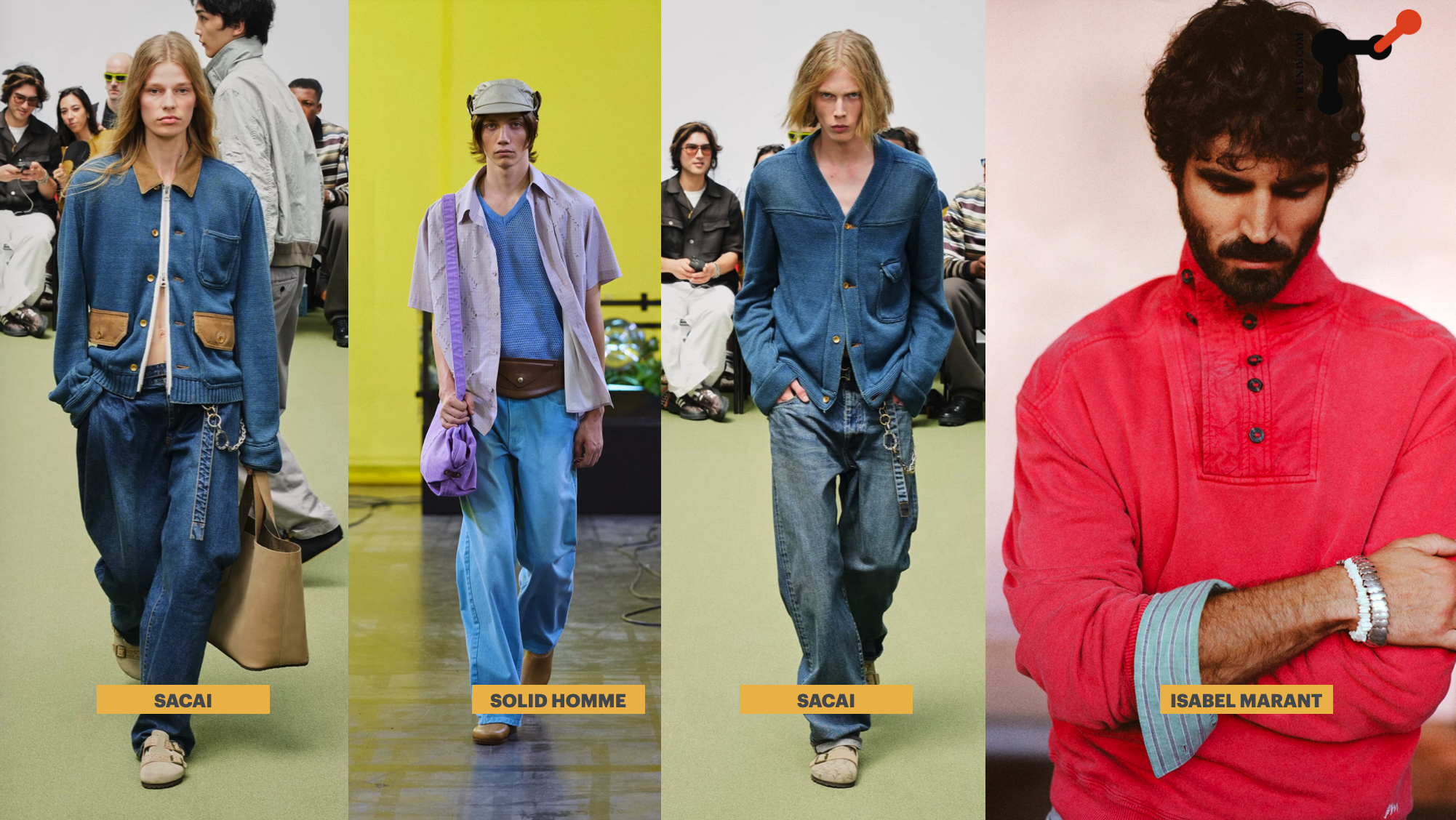
Key Designers: Sacai, Namechacko, Lemair, Isabel Marant, Solid Homme

In contrast to louder, more graphic-heavy aesthetics, our analytics have detected a sharp, stealthy rise in Modern Normcore. This refined evolution of the anti-fashion movement focuses on elevated, unassuming basics and functional minimalism. While it may appear visually understated, its commercial trajectory is exceptionally strong.
Here is the data-driven lifecycle of Modern Normcore and how to position it for your brand:
-
The Quiet Emergence (Spring/Summer 2026): Modern Normcore first registered on our analytics in the SS26 season with a marginal 0.1% market adoption. At its inception, it acted as a palate cleanser—a micro-trend adopted by fashion purists moving away from logomania and complex styling.
-
The Sudden Inflection Point (Spring/Summer 2027): SS27 represents the crucial acceleration phase for this aesthetic. Market adoption is forecasted to reach 0.7%. While this number seems small in the grand scheme of the broader market, it represents a massive proportional leap (a 7x multiplier) from its debut. This sudden, steep growth curve serves as a major early signal of shifting consumer appetites toward minimalist, utility-driven wardrobes.
-
The Mainstream Boom (Spring/Summer 2028): The momentum gathered in 2027 is merely the runway for a massive commercial expansion. Our predictive models indicate that Modern Normcore will grow by a staggering 3% in the SS28 season, transitioning it from an insider aesthetic to an absolute commercial necessity.
The Strategic Takeaway: For the upcoming SS27 season, Modern Normcore must be treated as a highly strategic niche product category. Because the sudden growth is acting as an early market indicator, brands should not yet overhaul their entire collections. Instead, introduce it through carefully curated, high-quality capsule collections or elevated basics. By testing and validating these niche products in the 2027 market, your brand will establish the supply chain, design language, and consumer trust necessary to fully capitalize on the massive 3% market boom arriving in 2028.
Minimalist Urban Utility

This look draws heavily from the mid-20th-century shift toward functionalism in menswear. The oversized wool overcoat references the structured tailoring of the 1940s and 50s. At the same time, the relaxed, monochromatic underlayers reflect a postmodern rejection of excessive ornamentation, prioritizing silhouette and material quality over decoration.

Here is the expanded and refined breakdown for the Minimalist Urban Utility trend, tailored to maintain the authoritative, data-driven tone of your forecasting report:
The Explosive Ascent of "Minimalist Urban Utility"
Bridging the gap between high-performance outerwear and sleek city apparel, Minimalist Urban Utility is emerging as a structural powerhouse in the menswear market. Our data highlights a staggering velocity behind this aesthetic, driven by a consumer demand for functional, multi-purpose garments that do not sacrifice clean, sophisticated design.
Here is the analytical breakdown of this trend's hyper-growth and how to leverage its momentum:
-
The Functional Foundation (Spring/Summer 2026): We first tracked the emergence of Minimalist Urban Utility during the SS26 season. Initially, it resonated as an early-adopter evolution of gorpcore, where consumers began trading brightly colored outdoor gear for sleek, muted, and highly functional citywear.
-
The Hyper-Growth Phase (Spring/Summer 2027): SS27 represents the definitive peak for this trend's cultural breakout, currently sitting at a 1.1% adoption rate. However, the most critical metric for brands to observe is the trend's current momentum, which has skyrocketed by an unprecedented +3466.7%. This phenomenal surge indicates viral consumer adoption and massive, immediate commercial viability.
-
The Mainstream Domination (Spring/Summer 2028): Driven by this explosive momentum, our forecasting models project Minimalist Urban Utility to scale rapidly over the next year. By the SS28 season, we expect it to secure an incredibly dominant 4% market adoption rate, solidifying its status as a core, foundational pillar of modern menswear.
The Strategic Takeaway: An astronomical momentum increase of +3466.7% is a rare and urgent market signal. With SS27 adoption at 1.1%, the trend is rapidly exiting the niche phase and hurtling toward mass-market appeal. Brands must act immediately to capture this wave. For smaller labels, this is the moment to aggressively market technical fabrics and modular designs. For larger retailers, SS27 is the final window to introduce this aesthetic as an innovative, trend-leading category before it becomes a standard, highly saturated market expectation in 2028.