
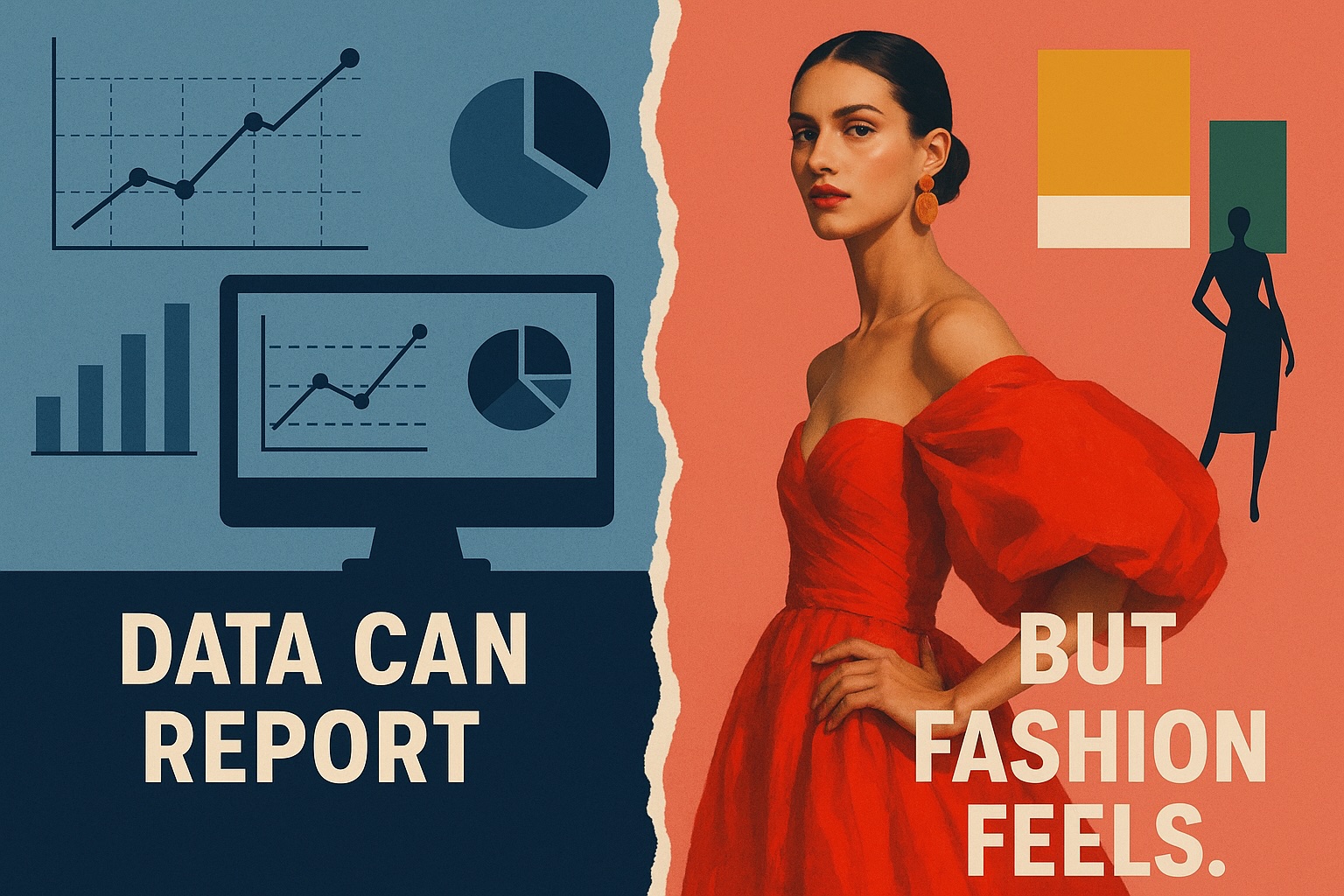
The Data-Only Fashion Forecasting Fraud: Why Retail Analytics Platforms Are Failing the Industry
When 95% of Fashion Decisions Are Emotional, Data Alone Cannot Predict What Consumers Will Want
The fashion industry has been sold a dangerous illusion. Over the past decade, a wave of retail analytics and trend forecasting platforms has promised brands the ability to predict consumer demand through data science. These platforms collect sales figures, track e-commerce transactions, monitor social media engagement, and apply machine learning algorithms to generate trend predictions. They present themselves as the future of fashion intelligence—objective, scientific, and reliable. But beneath the sophisticated dashboards and impressive statistics lies an uncomfortable truth: data-only fashion forecasting is fundamentally broken, and it is costing the industry billions.
The evidence is overwhelming. Despite unprecedented investment in retail analytics technology, the fashion industry continues to struggle with overproduction, generating approximately 92 million tonnes of textile waste annually according to the United Nations Environment Programme (UNEP). Research published in the Clothing and Textiles Research Journal found that AI-driven prediction accuracy remains remarkably low—in one rigorous study, data-based forecasting achieved only 8.3% accuracy against professional trend forecasts. The reason is not technological failure but conceptual fraud. These platforms are built on assumptions that contradict how fashion actually works, how consumers actually decide, and how trends actually form.
The 95/5 Rule: Why Fashion Is an Emotional Industry
Fashion is not a rational purchase category. According to Harvard Business School professor Gerald Zaltman, author of How Customers Think: Essential Insights into the Mind of the Market, approximately 95% of purchasing decisions are made subconsciously, driven by emotional responses rather than rational analysis. Gallup's extensive consumer research confirms this finding, demonstrating that about 70% of brand decisions are based on emotional factors, with only 30% based on rational considerations. In fashion, where personal expression and identity are paramount, these percentages likely skew even higher toward emotion.
When a consumer chooses a garment, they are not conducting a logical analysis of fabric quality, construction methods, and price-per-wear calculations. They are responding to something deeper—an emotional connection that operates largely below conscious awareness. Research published by neuroscientists reveals that the human brain processes emotional stimuli 3,000 times faster than rational thought. The limbic system, our brain's emotional centre, activates long before the neocortex engages in logical analysis, essentially pre-determining choices before conscious evaluation begins.
Colour is the primary driver of this emotional connection. Research published in the Saudi Journal of Business and Management Studies found that colour psychology is one of the main features determining consumer behaviour in the apparel market. Studies show that up to 85% of consumers cite colour as a primary reason for purchasing a particular product. Before a consumer evaluates silhouette, pattern, or fabric, they respond to colour. This response is instantaneous, unconscious, and deeply personal—shaped by cultural associations, individual psychology, seasonal mood, and current life circumstances.
This emotional foundation creates a fundamental problem for data-only forecasting platforms. Data captures what happened—transactions completed, items purchased, searches conducted. But it cannot capture why these events occurred. It cannot measure the emotional journey that led a consumer to choose emerald green over navy blue, or oversized silhouettes over fitted shapes. Without understanding the why, platforms are left correlating outcomes without comprehending causes. They are reading symptoms while ignoring the disease.
Data Is for the Dead: The Fatal Flaw of Historical Analytics
Here is the uncomfortable truth that data-only platforms refuse to acknowledge: sales data describes dead consumers, not living ones. The moment a transaction is recorded, it becomes historical—a record of who the consumer was, not who they are becoming. Human beings are not static entities. They evolve, grow, and transform. Their emotional needs shift with life circumstances, cultural movements, economic conditions, and countless other factors that no algorithm can fully model.
Research from the International Journal of Fashion Design, Technology and Education comparing traditional forecasting with big data tools found revealing limitations. While both approaches could generate similar predictions for broad categories like colour and pattern, they diverged significantly on design details—the nuanced elements that often determine commercial success. The study concluded that big data tools demonstrate clear limits for trend forecasting as a creative activity.
When a platform analyses last season's sales to predict next season's trends, it assumes that past behaviour reliably predicts future behaviour. In categories like groceries or household supplies, this assumption holds reasonably well. But fashion operates differently. Fashion is aspirational, not habitual. Consumers buy clothes not to repeat their past selves but to express their evolving identity. They purchase garments that represent who they want to become, not who they were. These platforms are not forecasting the future; they are extrapolating the past. In an industry defined by change, this approach is not just ineffective—it is fundamentally fraudulent.
The Conscious and Subconscious Mind: What Data Cannot See
Nobel Prize winner Daniel Kahneman's groundbreaking research revealed that our minds operate using two distinct systems when making decisions. System 1 thinking operates automatically and intuitively—processing information quickly, relying on emotions and mental shortcuts. System 2 thinking is deliberate, analytical, and requires conscious effort. According to consumer psychology research, System 1 governs approximately 95% of our purchasing behaviour. Data-only platforms can only capture conscious behaviour—the click, the purchase, the search query. They cannot see the emotional resonance that preceded these actions.
Research from Gallup partnering with Nihon University combined engagement data with fMRI brain imaging techniques. When researchers examined the brain scans of customers with high brand engagement, they found that the emotional centres of their brain—particularly those associated with passion—were activated. This neurological connection explains why consumers develop deep loyalty to certain brands, treating them as extensions of their personal narrative rather than mere products. Data cannot measure these subconscious activations.
The result is a forecasting approach that mistakes the tip of the iceberg for the entire mass. Platforms analyse visible transactions while ignoring the vast submerged structure of emotional motivation that determines which products succeed. They optimise for measurable outcomes while remaining blind to the unmeasurable causes. This is not sophisticated intelligence—it is wilful ignorance dressed in technological clothing.
The Continuous Emotional Journey: Why Trends Cannot Be Predicted from Sales Data
Fashion trends emerge from collective emotional shifts, not from sales pattern analysis. When minimalism rises, it reflects a cultural mood seeking calm amid chaos. When maximalism returns, it signals a collective desire for self-expression and joy. These movements begin in the creative imagination—on runways, in design studios, in cultural conversations—long before they appear in retail data. By the time a trend shows up in sales figures, it has already peaked among early adopters and is beginning its descent into mass-market saturation.
The Sustainable Fashion Forum's research on consumer psychology notes that the immediacy of satisfaction derived from purchasing trendy clothing is a powerful psychological trigger—one that operates on emotional and social dimensions that data cannot capture. Consumers exist on a continuous emotional journey, influenced by global events, cultural shifts, personal circumstances, and evolving self-perception. This journey does not proceed in predictable patterns that algorithms can model.
A pandemic changes how people relate to comfort and home. Economic uncertainty shifts attitudes toward investment dressing. Social movements transform what consumers want their clothing to communicate. None of these influences appear in sales data until their effects have already manifested. Data-only platforms are structurally incapable of anticipating these shifts. They can identify that sales of loungewear increased last quarter, but they cannot understand the emotional need for comfort and security that drove this increase.

Why Most Catwalk Trend Analytics Platforms Fail: The Granularity Gap
Beyond the fundamental problem of emotional blindness, most catwalk analytics platforms fail at a more basic level: they lack the granularity required for actionable fashion intelligence. These platforms provide generic category-level data that is virtually useless for design and merchandising decisions. The gap between what they deliver and what brands actually need represents one of the greatest unspoken failures in fashion technology.
Generic Categories Instead of Actionable Design Intelligence
Most platforms tell you that "short pants are trending" or "V-neck tops are popular." This information is worthless for a design team trying to create a commercially viable collection. What a brand actually needs to know is far more specific: are short pants with drawstring waistbands and ruffle details in PANTONE 19-0915 June Bug gaining momentum? Is the women's V-neck top with bubble sleeves in PANTONE 16-1220 Cuban Sand showing growth trajectory?
The difference between "short pants" and "short pants with drawstring and ruffle details in a specific Pantone colour" is the difference between useless information and actionable intelligence. Generic category data forces design teams to guess at the details that actually determine commercial success. It provides the illusion of insight while delivering nothing that can inform a production decision. F-Trend AI Catwalk delivers the granular, design-specific intelligence that transforms trend data into products that sell.
No Colour Harmony Intelligence: Declining Harmonies vs Declining Colours

Colour in fashion does not exist in isolation. It exists in relationship—in harmonies, contrasts, and combinations that create emotional impact. Most analytics platforms track individual colours rising or falling in popularity. This misses the point entirely. A colour may be declining as a standalone choice while simultaneously gaining momentum as part of a specific harmony. Conversely, a trending colour may be losing relevance in certain combinations while maintaining strength in others.
F-Trend's ColorAnalyzer goes beyond single-colour tracking to analyse colour harmony trends. The platform identifies which colour relationships are gaining or losing traction—complementary pairs, analogous groupings, triadic combinations, and split-complementary schemes. This harmony-level intelligence enables brands to create collections with colour stories that resonate emotionally, rather than simply chasing individual trending hues that may not work together.
No Colour Tone Analysis: Jewel Tones vs Generic Hex Values
Most platforms reduce colour to hex values—a six-character code that tells you nothing about emotional resonance or design application. But colour families and tones carry distinct psychological meanings. Jewel tones—rich emeralds, deep sapphires, luxurious amethysts—communicate opulence, sophistication, and premium positioning. Earth tones suggest naturalness and sustainability. Pastels evoke softness and approachability. Neons signal energy and youth.
F-Trend's colour intelligence operates at the tone family level, tracking the rise and fall of jewel tones, earth tones, pastels, neons, neutrals, and other colour families as distinct trend categories. This enables brands to make strategic colour decisions aligned with their positioning and target consumer psychology, rather than chasing random hex values divorced from emotional context.
No Brightness and Saturation Index: The Missing Dimensions of Colour
Colour has three dimensions: hue, saturation, and brightness. Most platforms track only hue—whether red, blue, or green is trending. They completely ignore saturation (colour intensity) and brightness (light vs dark values). Yet these dimensions carry enormous emotional weight. Highly saturated colours feel energetic and bold; desaturated tones feel sophisticated and subtle. Bright colours communicate optimism and youth; darker values suggest maturity and elegance.
F-Trend analyses colour trends across all three dimensions. The platform tracks whether consumers are gravitating toward high-saturation or muted versions of trending hues, whether brightness is shifting toward light or dark applications, and how these dimensional preferences vary across categories, seasons, and demographics. This multi-dimensional colour intelligence enables nuanced design decisions that generic hue-tracking cannot support.
No Print-Based Colour Intelligence: Colour Context Matters
A colour behaves differently as a solid versus as part of a print. Navy may be declining as a solid colour for dresses while simultaneously gaining momentum in floral prints for blouses. Coral may be trending in geometric patterns while stagnating in abstract prints. Most platforms cannot distinguish between colour performance in solids versus prints, let alone across different print categories.
F-Trend's PatternAnalyzer integrates with colour intelligence to track how colours perform within specific print contexts. The platform identifies which colours are gaining traction in florals, geometrics, abstracts, animal prints, stripes, and other pattern categories. This contextual colour intelligence enables brands to make print-specific colour decisions rather than applying generic colour trends inappropriately across all applications.
They Report Trends, Not Predict Colours: The Fundamental Failure
Perhaps the most damning limitation of data-only platforms is their fundamental orientation: they tell you what colours are trending, not what colours will trend. They are reporters, not forecasters. They observe and aggregate; they do not anticipate or predict. By the time their data shows a colour gaining momentum, the production window for capitalising on that trend has already closed for most brands.
F-Trend AI Catwalk is built for prediction, not reporting. By analysing runway shows at the point of creative origin—before trends reach mass adoption—F-Trend identifies colour directions 6-12 months ahead of market manifestation. The platform's predictive algorithms, combined with its understanding of colour psychology and emotional drivers, enable genuine colour forecasting rather than historical colour reporting. Brands using F-Trend don't follow trends; they anticipate them.
The Cost of Getting It Wrong: Fashion's Waste Crisis
The consequences of data-only forecasting failures are not abstract. According to the Ellen MacArthur Foundation, every second the equivalent of a rubbish truck load of clothes is burnt or buried in landfill. The UNEP reports that global textile waste reached 92 million tonnes annually, with projections reaching 148 million tonnes by 2030. The U.S. Government Accountability Office's landmark 2024 report confirmed that the fashion industry produces nearly 10% of global greenhouse gas emissions—more than aviation and maritime shipping combined.
Research from The Interline estimates that between 80 and 150 billion garments are made yearly, with 8 to 60 billion remaining unsold. This overproduction stems directly from inefficient demand forecasting that fails to account for emotional and creative dimensions of consumer behaviour. McKinsey reported that the number of garments produced annually has doubled since 2000, yet the average piece of clothing is worn 36% fewer times than 15 years ago. The industry is producing more while understanding consumers less.
F-Trend AI Catwalk: Creative Intelligence for the Living Consumer
F-Trend AI Catwalk was built on a fundamentally different philosophy. Rather than treating fashion as a data problem to be solved through computational force, F-Trend recognises fashion as a creative and emotional discipline that requires creative and emotional intelligence. The platform combines advanced AI analytics with deep understanding of consumer psychology, delivering trend forecasting that captures both the measurable and the meaningful.
F-Trend's approach begins where trends actually originate: the runway. By analysing 16,000+ designs from 50+ global fashion weeks, the platform captures creative vision at its source—before mass adoption dilutes innovation into generic market data. This upstream positioning enables F-Trend to identify emerging trends 6-12 months ahead of market appearance, providing brands with genuine predictive intelligence rather than historical pattern recognition.
The platform's proprietary ColorAnalyzer achieves 98% accuracy in colour detection while delivering the granular, multi-dimensional colour intelligence that competitors lack. F-Trend tracks colour harmonies, tone families, saturation indices, brightness values, and print-specific colour performance. The system incorporates consumer psychology insights that connect colour trends to emotional drivers. Brands learn not just what colours are emerging, but why consumers will respond to them, enabling creative decisions grounded in emotional truth rather than statistical abstraction.
F-Trend's SilhouetteAnalyzer delivers 89% accuracy with design-specific granularity—not "short pants trending" but specific combinations of silhouette, details, and finishes. The PatternAnalyzer tracks 759 pattern variations with colour-integrated intelligence. The FabricAnalyzer provides comprehensive material intelligence including sustainability metrics. Together, these tools deliver the actionable, design-level intelligence that generic category data cannot provide.
Understanding the Emotional Journey: F-Trend's Contextual Intelligence
What truly distinguishes F-Trend is its commitment to understanding the continuous consumer emotional journey. The platform's advanced filtering system analyses trends by region, designer, season, and demographic—recognising that emotional drivers vary across cultures, contexts, and consumer segments. A colour that signals sophistication in Milan may communicate playfulness in Tokyo. A silhouette that resonates with Gen Z may alienate older consumers. F-Trend captures these nuances, delivering intelligence tailored to each brand's specific market and audience.
The platform achieves 94% overall accuracy in trend identification and 68% accuracy in next-season predictions—performance that dramatically outpaces data-only alternatives stuck at single-digit accuracy rates. This accuracy gap reflects the fundamental difference between analysing dead data and understanding living consumers. F-Trend's predictions succeed because they are grounded in creative intelligence that mirrors how fashion actually works: emotion first, attributes second, always evolving, always human.
For designers and creative teams, F-Trend provides validation tools that honour artistic vision while ensuring market relevance. The platform does not replace creative intuition with algorithmic diktat—it enhances intuition with emotional intelligence, helping designers understand whether their concepts align with the collective mood or represent genuine innovation ahead of the curve.
The Choice: Dead Data or Living Intelligence
The fashion industry stands at a crossroads. One path leads deeper into the data-only illusion—platforms that promise scientific precision while delivering single-digit accuracy, that provide generic categories while missing design-level granularity, that report on yesterday's trends while failing to predict tomorrow's colours. This path has produced an industry drowning in overproduction, struggling with sustainability, and failing to connect with consumers on the emotional level that fashion demands.
The other path embraces the truth about fashion: that it is fundamentally an emotional industry serving living, evolving consumers whose decisions emerge from complex psychological journeys that no amount of historical data can fully model. This path requires forecasting platforms built on creative intelligence—tools that combine analytical precision with emotional understanding, that deliver design-level granularity with colour harmony intelligence, that predict the future rather than report the past.
F-Trend AI Catwalk represents this second path. The platform was designed for an industry where emotion dominates, where colour speaks before reason engages, where consumers make choices that data alone cannot explain. With its integration of runway analysis, consumer psychology, multi-dimensional colour intelligence, and design-level granularity, F-Trend delivers what data-only platforms cannot: genuine understanding of the living consumer and their continuous emotional journey.
The data-only forecasting fraud has cost the fashion industry enough. It is time for intelligence that matches how fashion actually works—creative, emotional, alive. F-Trend AI Catwalk is that intelligence. For brands ready to stop chasing dead data and start connecting with living consumers, the superhero has arrived.
References & Sources
1. Zaltman, G. (2003). How Customers Think: Essential Insights into the Mind of the Market. Harvard Business School Press.
2. Gallup Research. "Customer Brand Preference and Decisions: Gallup's 70/30 Principle." gallup.com/workplace/398954
3. Kahneman, D. (2011). Thinking, Fast and Slow. Farrar, Straus and Giroux.
4. Casas & Chinoperekweyi (2019). "Color Psychology and Its Influence on Consumer Buying Behavior: A Case of Apparel Products." Saudi Journal of Business and Management Studies.
5. DuBreuil, M. & Lu, S. (2020). "Traditional vs. Big-Data Fashion Trend Forecasting." International Journal of Fashion Design, Technology and Education, 13(1), 68-77.
6. Ryu, C. & Lee, Y.K. (2025). "How the Field of Fashion can use ChatGPT to Predict Fashion Trends." Clothing and Textiles Research Journal.
7. United Nations Environment Programme (2025). "Unsustainable fashion and textiles in focus for International Day of Zero Waste." unep.org
8. Ellen MacArthur Foundation (2017). A New Textiles Economy: Redesigning Fashion's Future.
9. U.S. Government Accountability Office (2024). "Textile Waste and Fast Fashion's Environmental Toll." gao.gov
10. The Interline (2024). "Understanding Overproduction." theinterline.com
11. McKinsey & Company. "The State of Fashion." Annual Industry Report.
12. Sustainable Fashion Forum (2023). "The Psychology of Consumption: Decoding What Drives Our Purchasing Behavior." thesustainablefashionforum.com
13. Research and Metric (2025). "Consumer Psychology Buying Decisions: 95% Are Emotional." researchandmetric.com
14. Woven Insights (2025). "How Colors Influence Buying Decisions in Fashion." woveninsights.ai
15. Labrecque, L.I. & Milne, G.R. (2012). "Exciting red and competent blue: the importance of color in marketing." Journal of the Academy of Marketing Science.