
- Where
- Fashion Forecast → Design intelligence tab
- Steps
- 4
- Time
- About 6 min
Before you start: A colour direction — Design intelligence builds on its themes.
Step 1: Start with the design archetypes
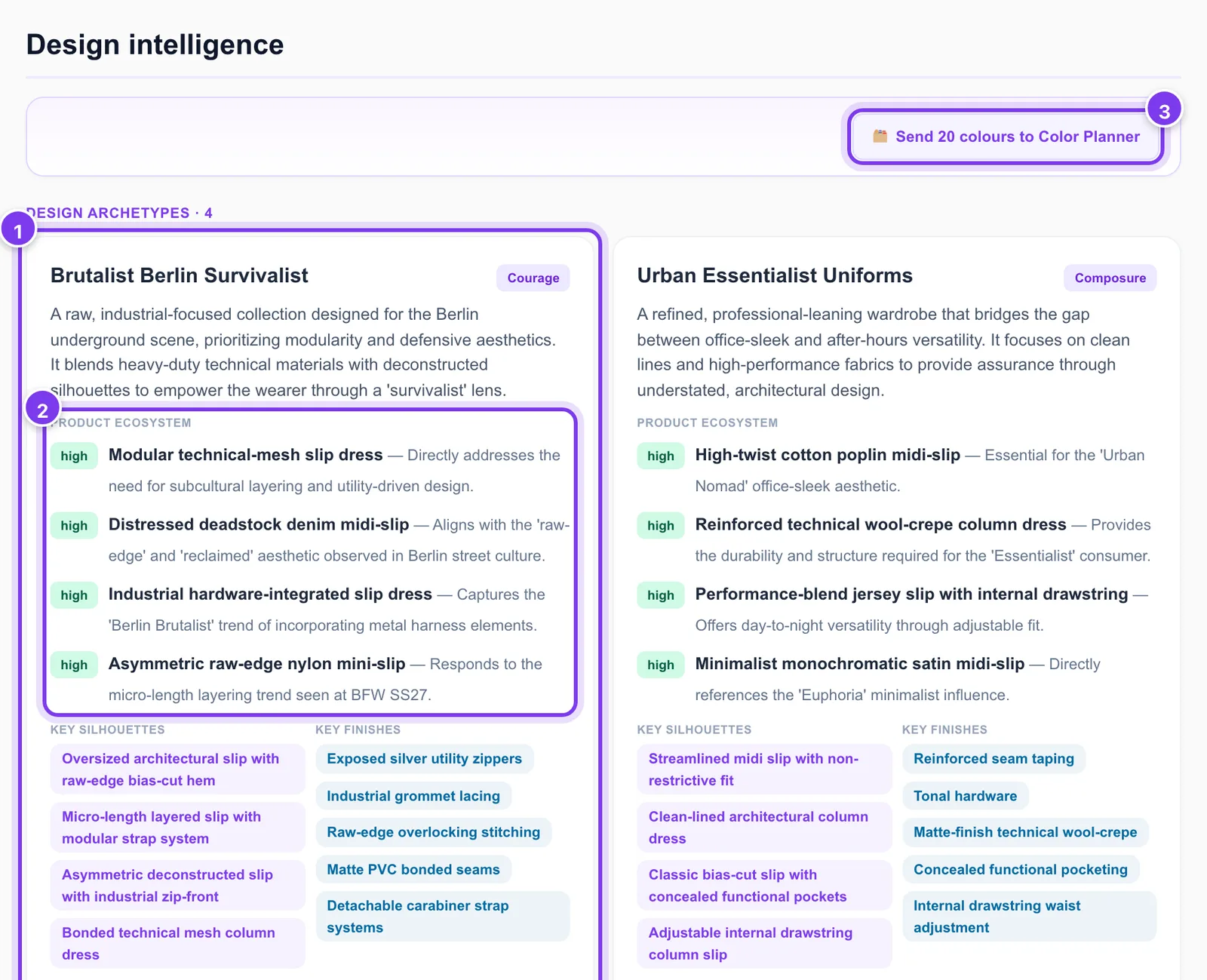
Design intelligence archetype cards with their product ecosystems, key silhouettes and finishes, and the Send colours to Color Planner button. Each archetype restates a colour theme as a collection idea — here Brutalist Berlin Survivalist, for Courage — and lists its product ecosystem: the garments to develop, each with a confidence level and a one-line reason.
- Archetype — the collection idea and the emotion it answers.
- Product ecosystem — garments to develop, ranked by confidence, each with its reason.
- Send colours to Color Planner — moves the archetype palettes into the planner.
Step 2: Trace every idea back to its signal
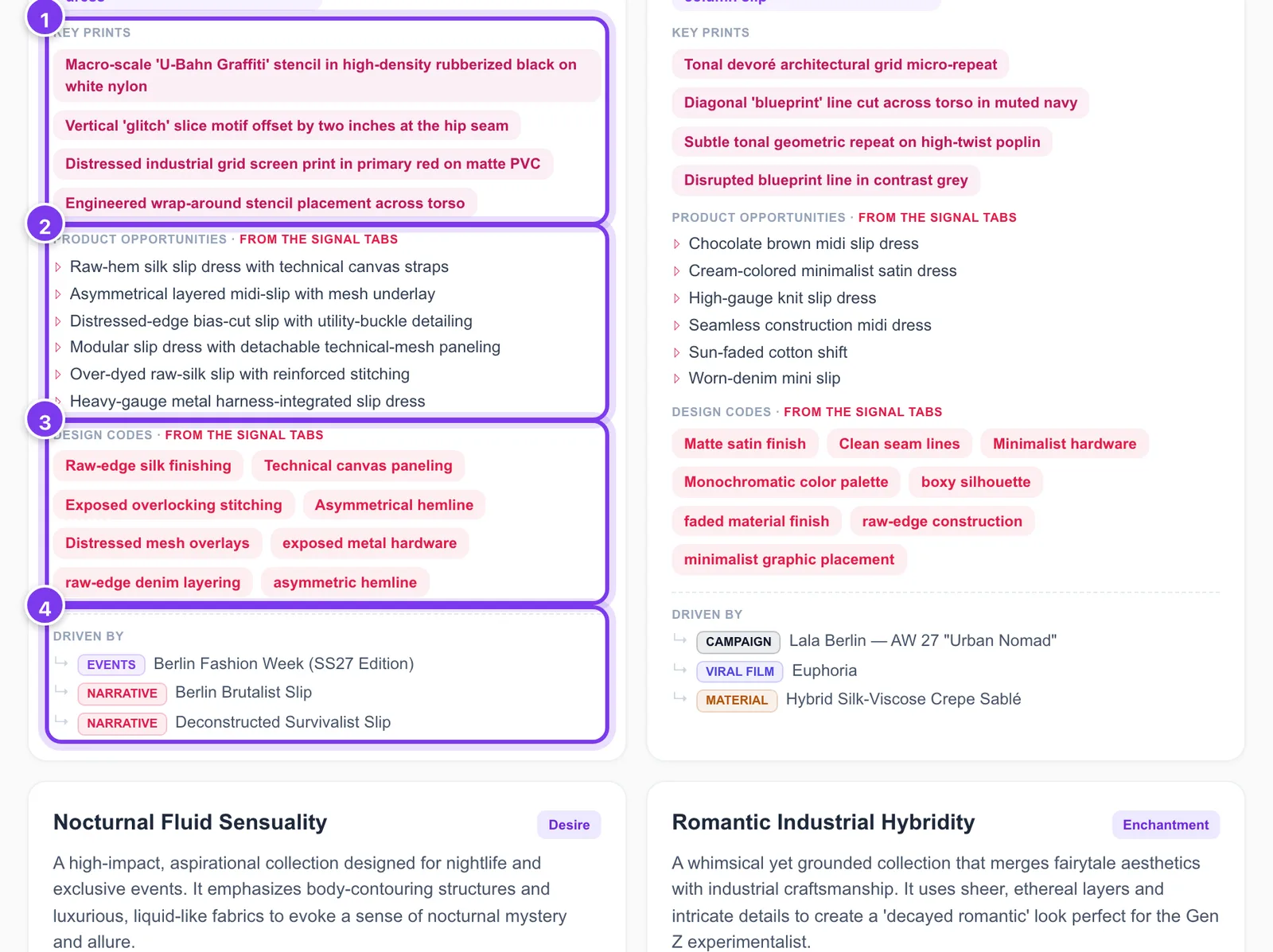
Archetype detail with key prints, product opportunities and design codes from the signal tabs, and the Driven by list. Below the ecosystem, each archetype lists key prints, then the product opportunities and design codes it took from the signal tabs. Driven by names the exact events, narratives, campaigns, materials and runway trends behind it — so any idea in the plan can be traced to evidence.
- Key prints — the print directions for the archetype.
- Product opportunities — garments carried over from the signal tabs.
- Design codes — recurring design cues from the signal tabs.
- Driven by — the specific signals the archetype was built from.
Step 3: Check print direction, consumer and timing
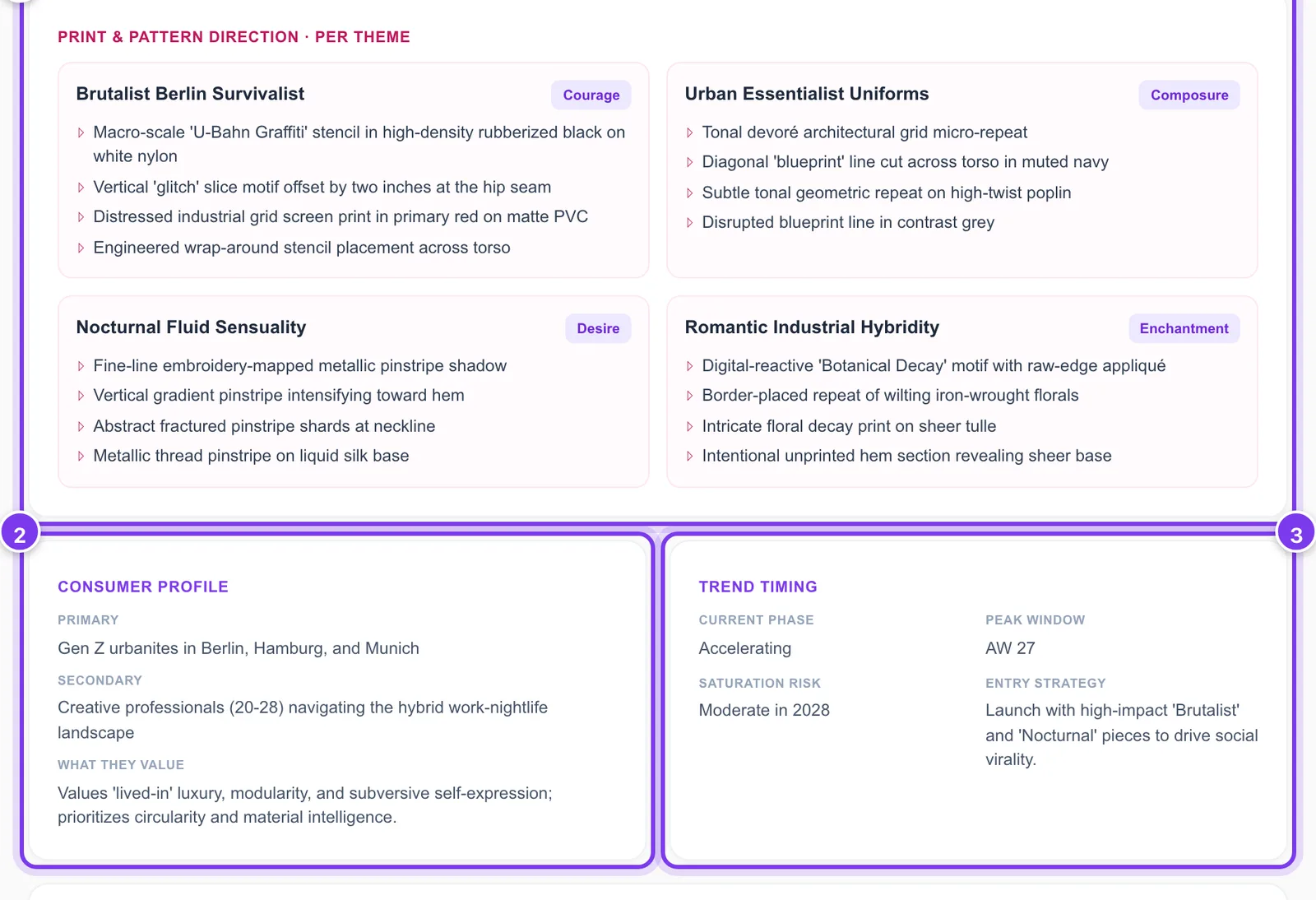
Print & pattern direction per theme, the consumer profile, and trend timing with phase, peak window, saturation risk and entry strategy. Print & pattern direction gives each theme its motifs. Consumer profile describes the primary and secondary consumer and what they value. Trend timing gives the current phase, peak window, saturation risk and entry strategy. Retail tiers, just below, rate how well the direction fits each channel.
- Print & pattern direction — motifs per theme.
- Consumer profile — primary and secondary consumer, and what they value.
- Trend timing — phase, peak window, saturation risk and entry strategy.
Step 4: Brief the team
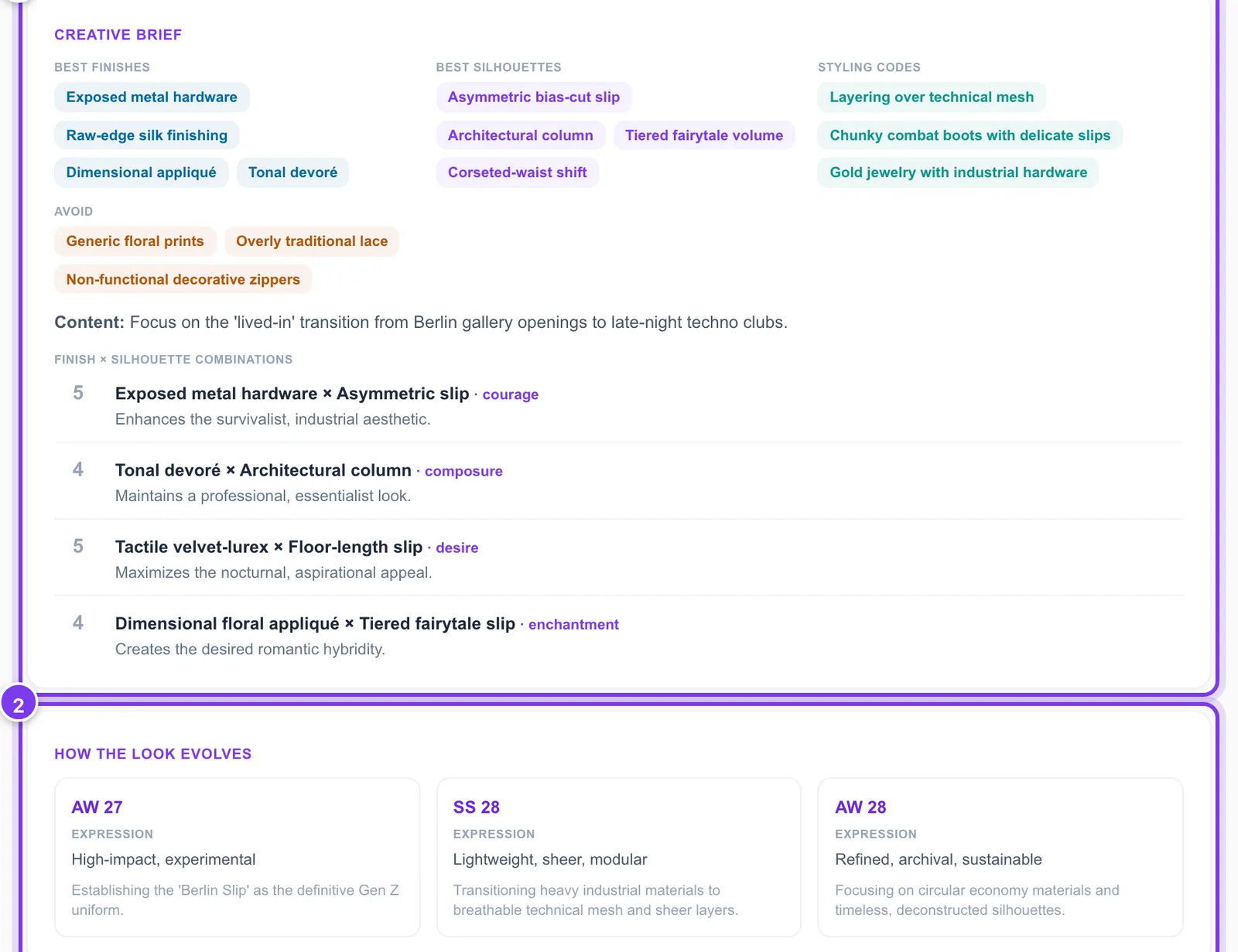
The creative brief with best finishes, silhouettes, styling codes, avoid list and finish × silhouette combinations, and How the look evolves across AW 27, SS 28 and AW 28. Creative brief lists the best finishes, best silhouettes, styling codes and what to avoid, then content direction and the strongest finish × silhouette combinations, each tagged with its emotion. How the look evolves carries the direction across the next three seasons.
- Creative brief — finishes, silhouettes, styling codes, what to avoid and the strongest combinations.
- How the look evolves — the same direction across the next three seasons.
What you have now
A design plan your team can brief from, with every archetype traceable to its signals — and the input to generating a design board.
Frequently asked
Is the design plan invented from scratch?
No. It is built on the colour direction and the signal lanes: archetypes come from the colour themes, product opportunities and design codes are carried over from the signal tabs, and each archetype shows a Driven by trail.
Can I plan a range from it?
Yes. Range architecture, built on the design plan, lays the season out as stories and options with carry-over versus new development.
Keep reading
How do I build a colour direction in F-Predict?
Open the Colour direction tab once the consumer map and designer campaigns have run. F-Predict groups colours into themes, each tied to a consumer emotion…
How do I generate a design board in F-Predict?
Open the Design board tab, pick a design-plan archetype and a seed colour from its palette, choose an image style — Flat-lay, Textile, Runway, Lifestyle, M…
How does F-Predict help product development?
F-Predict supports product development by converting a forecast into decisions a range plan can absorb: named colour themes with Pantone references, materi…